
The commercial transport landscape across Pakistan is undergoing a massive paradigm shift. For decades, small businesses, wholesale traders, and distribution networks relied entirely on high-maintenance petrol and diesel cargo variants. However, skyrocketing fuel prices, frequent mechanical breakdowns, and unpredictable operating overheads have forced a critical transition.
In 2026, electric loaders have officially moved from a futuristic alternative to the primary backbone of urban logistics and small-scale commercial supply chains. With significant leaps in local assembly, localized spare parts availability, and robust battery management systems tailored for regional weather conditions, transitioning to an EV loader is the smartest operational upgrade a business can make this year.
The Economics of EV Loaders: Why Small Businesses are Shifting
Operating a traditional 150cc or 200cc petrol loader rickshaw in the current economic climate poses a severe challenge to profit margins. Conventional internal combustion engines (ICE) struggle under immense payloads, leading to rapid clutch plate wear, frequent engine oil changes, and poor fuel economy.
Electric loaders eliminate these structural pain points by introducing a highly optimized mechanical setup:
- Decoupled Fuel Costs: Charging a lithium-ion pack costs a fraction of a liter of petrol, bringing down the cost-per-kilometer drastically.
- Minimal Mechanical Moving Parts: Without pistons, valves, spark plugs, or traditional gearboxes, the need for routine tuning and engine overhauls is entirely eliminated.
- Instantaneous Low-End Torque: Electric motors deliver maximum torque from 0 RPM. This means an EV loader can pull heavy cargo up steep inclines or broken urban roads far more effortlessly than a sputtering petrol engine.
- Thermal Resiliency: Modern commercial EV variants utilized in Pakistan now feature enhanced cooling channels to ensure battery safety during peak summer temperatures.
Deep-Dive: Top Electric Loader Recommendations for 2026
Evaluating an electric loader requires looking closely at battery capacity (Ampere-hours / AH), motor wattage, real-world loaded range, and structural chassis strength. Here is an honest review of the top options dominating the market.
1. Sazgar Tempo Electric Loader (125AH) – The Heavy-Duty Champion
- Target Segment: Wholesale distributors, dairy supply networks, and inter-city courier logistics.
- Battery & Range: Equipped with a premium 125AH Lithium battery pack, delivering an impressive 140–160 km of real-world range on a single charge.
- Performance Profile: Driven by a high-torque, heavy-duty electric motor designed specifically to handle maximum payloads without dropping speed.
- Charging Metrics: Requires roughly 6–7 hours for a full cycle using a standard commercial or home setup.
- Our Analysis: This is the undisputed leader for businesses whose daily routes span across multiple metropolitan zones. While the upfront investment is higher, the extended range guarantees zero range anxiety during long operational hours.
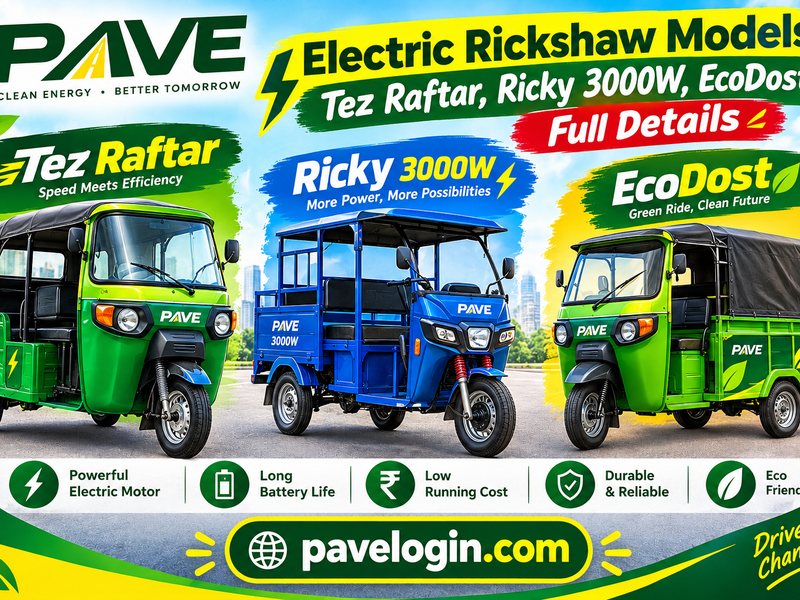
2. Ecodost Electric 3-Wheeler Loader – The Smart Budget Pick
- Target Segment: Urban shopkeepers, localized delivery riders, and startups looking for rapid ROI.
- Battery & Range: Powered by a robust 100AH Lithium chemistry setup, yielding a reliable 80–100 km range.
- Performance Profile: Features an efficient 3500W motor optimized for quick acceleration through dense city traffic.
- Charging Metrics: Highly efficient charging curve, reaching full capacity in just 3–4 hours.
- Our Analysis: Ecodost offers the most balanced price-to-performance ratio in the market. It is highly suited for business owners who operate within a defined 70–90 km daily radius and require fast mid-day top-ups.
3. Sazgar Tempo Electric Loader (90AH) – The Mid-Tier Workhorse
- Target Segment: Fruit and vegetable retailers, food delivery hubs, and sub-distribution agents.
- Battery & Range: Features a calibrated 90AH battery pack providing a clean 100–115 km operational boundary.
- Performance Profile: Backed by a strong 4kW motor that ensures high stability and torque distribution even when fully loaded.
- Charging Metrics: Recharges fully within a manageable 4–5 hours window.
- Our Analysis: If your business requires moving heavy cargo but doesn’t necessarily cover extreme distances, this 90AH variant offers Sazgar’s signature structural durability at a more accessible price point.
4. Siwa Electric Loader – Built for Short-Distance Utility
- Target Segment: Industrial estates, large warehouses, local hardware shops, and neighborhood intra-movements.
- Battery & Range: Utilizes a lightweight, mid-range lithium pack built for a localized 70–90 km range cycle.
- Performance Profile: Implements a highly economical 3kW motor tuned for steady, power-saving transport.
- Charging Metrics: Complete charging turnaround achieved in 4–5 hours.
- Our Analysis: An excellent entry-level option for businesses moving goods between close storage units or short commercial blocks where extreme high-speed performance is not a requirement.
Engineering Matrix: 2026 Loader Comparison
| Brand & Model | Battery Configuration | Realistic Loaded Range | Primary Operational Fit |
| Sazgar Tempo 125AH | 125AH Lithium Pack | 140–160 km | Intensive long-haul routes & heavy payloads |
| Ecodost EV Loader | 100AH Lithium Pack | 80–100 km | Fast-charging, budget-conscious urban routes |
| Sazgar Tempo 90AH | 90AH Lithium Pack | 100–115 km | Regular daily distribution with medium distance |
| Siwa Electric Loader | Mid-Range Lithium | 70–90 km | Hyper-local cargo movement & light retail tasks |
💡 Expert Column: Sizing Your Purchase to Your Route Profile
Operational Insight: “When transitioning your business to EV logistics, do not buy a loader based purely on its maximum cargo weight capacity. Instead, plot your exact daily route mileage first. If your drivers average 60km a day, purchasing an expensive 125AH model means you are paying for battery capacity you will rarely deplete. Conversely, putting a 70km-range loader onto a 90km route will force mid-day charging downtime, hurting your delivery timelines. Match the Ampere-hours (AH) strictly to your route profile.”
Buying Checklist for Commercial EV Vehicles
- Verify the Real Battery Lifecycles: Ensure the manufacturer provides a clear warranty on battery cycles. Lithium iron phosphate (LFP) or high-grade Lithium-ion variants should easily yield several years of daily cycling before any noticeable degradation.
- Assess Chassis Build Quality: A loader is meant to take abuse. Look closely at the suspension stiffness, rear leaf springs (kamani setup), and welding reinforcement around the cargo bed.
- Infrastructure Compatibility: Ensure your commercial facility or home garage has a stable, dedicated 220V power socket with appropriate circuit breakers installed to manage prolonged charging current safely.
Also Read About: Sazgar Tempo Electric Loader 90AH and 125AH Full Specifications
Frequently Asked Questions (FAQs)
What is the average fuel economy of a standard 200cc petrol loader rickshaw?
A conventional 200cc petrol loader typically delivers between 20 to 28 km per liter. This average drops significantly when hauling heavy weights or navigating bumper-to-bumper city traffic, making running costs highly volatile compared to fixed electricity costs.
What is the typical mileage per liter of a 150cc commuter bike like the Bajaj Avenger?
For comparison with personal or light delivery options, standard 150cc cruisers like the Bajaj Avenger generally achieve around 35 to 45 km per liter, depending heavily on speed maintenance, highway access, and overall engine health.
What are the most common industrial uses for 150cc cargo loaders in Pakistan?
150cc loaders are widely utilized for light-to-medium urban freight. This includes transporting daily wholesale groceries to retail shops, delivering fresh dairy and poultry products, shifting light construction materials (like paints, tiles, and piping), and managing supply transfers between centralized warehouses and retail hubs.
What architecture does a New Asia 150cc loader engine use?
The New Asia 150cc cargo loader runs on a traditional 4-stroke, single-cylinder air-cooled or water-cooled petrol engine. It relies heavily on routine oil replacements, spark plug maintenance, and manual clutch adjustments to remain operational under commercial strain.
Final Verdict: Which EV Loader Suits Your Business?
Investing in an electric loader in 2026 is the most definitive way to insulate your business from fluctuating fuel markets.
- For high-volume supply chains running rigorous schedules, the Sazgar 125AH is the premier choice.
- For quick city operations requiring low overheads and swift turnaround times, the Ecodost Loader provides unmatched economic utility.
- For standard retail operations running balanced routes, the Sazgar 90AH strikes the ultimate sweet spot between price and range performance.