
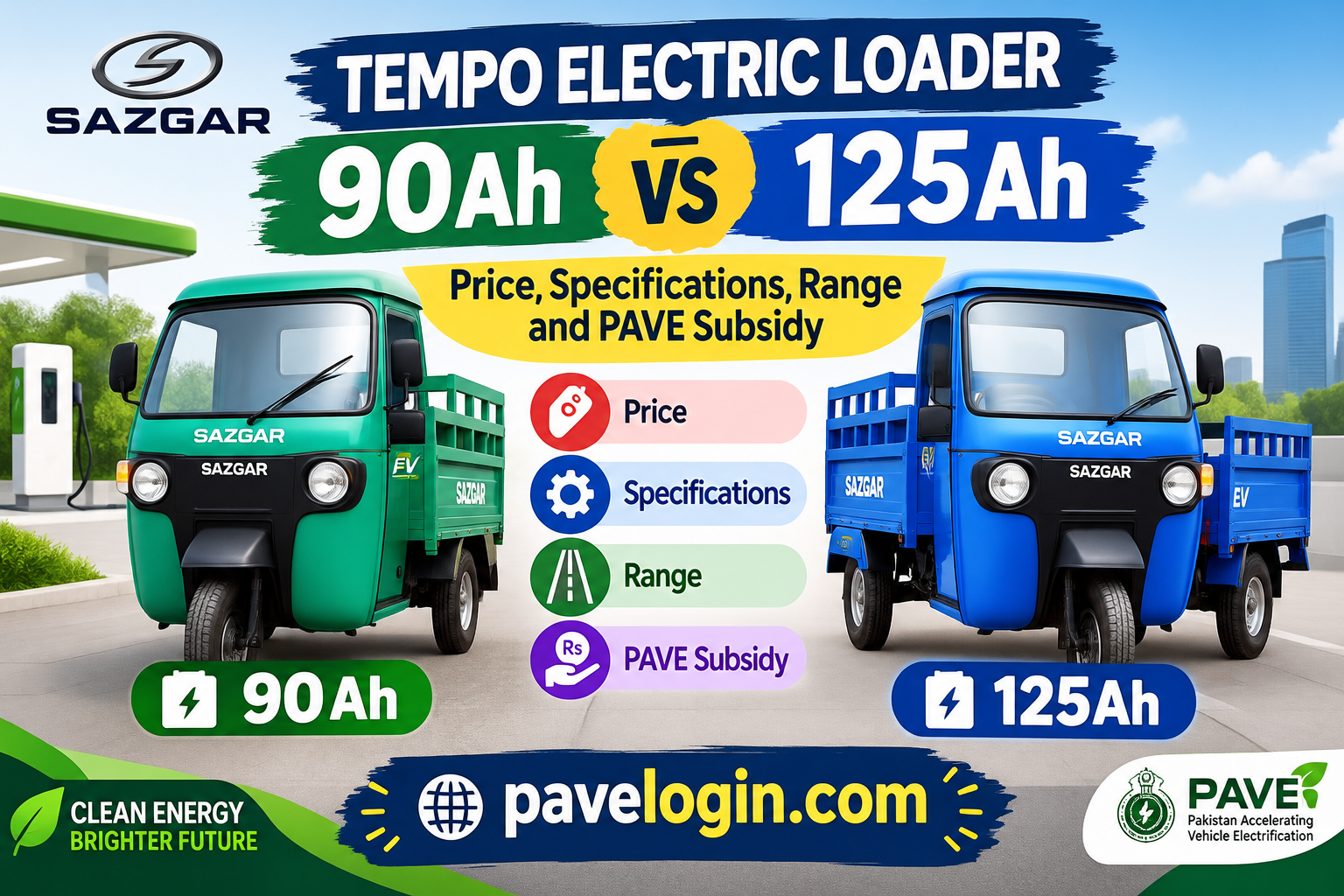
Electric loaders are becoming an increasingly visible part of Pakistan’s urban goods-transport market. Small retailers, courier operators, wholesalers, pharmacies, food businesses, and other businesses that move goods within cities are looking at electric three-wheelers as an alternative to conventional petrol-powered loaders.
The Sazgar Tempo Electric Loader is available in battery configurations that are commonly discussed as the 90Ah and 125Ah variants. The main difference between these versions is the battery capacity, which can affect usable range, charging requirements, vehicle cost, and the type of daily route for which the loader is practical.
This guide explains the reported specifications of both versions, how the battery difference affects daily operation, what buyers should check about the PAVE electric-vehicle subsidy, and how to calculate the actual running cost before purchasing.
Important: Electric-vehicle prices, subsidy rules, eligibility criteria, and vehicle specifications can change. The figures in this article should be treated as reported/reference figures rather than independent test results. Always confirm the current quotation, battery configuration, warranty, and subsidy eligibility with Sazgar and the relevant government or financing channel before making a purchase.
Sazgar Tempo Electric Loader at a Glance
The Tempo is intended for goods transportation rather than passenger commuting. For a business owner, the most important specifications are therefore not just motor power and top speed but also payload, battery capacity, range under load, charging time, service availability, and total operating cost.
The two commonly discussed battery configurations are:
- 90Ah: More suitable for businesses with shorter daily routes and access to overnight charging.
- 125Ah: Better suited to operators who need additional range and want to reduce the frequency of charging during a working day.
The actual suitability of either version depends on the daily distance, cargo weight, road conditions, and charging arrangements.
Sazgar Tempo Electric Loader 90Ah
The 90Ah version is the smaller-battery configuration of the two. It can make sense for businesses that mainly operate within a city and return to their premises regularly for overnight charging.
Reported Specifications
| Specification | Tempo 90Ah |
|---|---|
| Battery | 72V LiFePO4 |
| Battery capacity | 90Ah |
| Motor | Approximately 4kW PMSM |
| Reported top speed | Up to approximately 60 km/h |
| Reported range | Approximately 100–110 km |
| Reported charging time | Approximately 4–4.5 hours |
These figures can vary according to vehicle configuration and test conditions.
Battery capacity
A 72V 90Ah battery has a nominal energy capacity of approximately:
72 × 90 = 6.48 kWh
This is a theoretical battery-energy figure. The amount of electricity actually available for driving will differ because of battery-management settings, usable state-of-charge limits, temperature, and electrical losses.
Practical operating range
A quoted range of around 100–110 km should not be interpreted as a guaranteed distance in every situation.
A loader carrying heavy cargo, travelling at higher speeds, or operating on inclines can consume considerably more energy than a lightly loaded vehicle travelling at moderate speeds.
For commercial users, it is safer to calculate daily requirements with a reserve rather than planning a route around the maximum advertised range.
Who may consider the 90Ah version?
The 90Ah configuration may be appropriate for:
- Local shop deliveries
- Short-distance distribution
- Pharmacy and grocery deliveries
- Small wholesale businesses
- Urban courier work
- Businesses with predictable daily routes
The key advantage is that the smaller battery can potentially reduce the initial purchase cost compared with a larger-capacity configuration.
Sazgar Tempo Electric Loader 125Ah
The 125Ah version uses a larger battery capacity and is aimed at users who need greater daily driving range.
Reported Specifications
| Specification | Tempo 125Ah |
|---|---|
| Battery | 72V LiFePO4 |
| Battery capacity | 125Ah |
| Motor | Approximately 4kW PMSM |
| Reported top speed | Up to approximately 60 km/h |
| Reported range | Approximately 140–150 km |
| Reported charging time | Approximately 6–6.5 hours |
Larger battery, greater energy storage
At a nominal 72V, a 125Ah battery represents approximately:
72 × 125 = 9.0 kWh
That is substantially more nominal energy storage than the 90Ah version.
The benefit is potentially greater driving range between charges. The trade-off is that a larger battery generally means a higher purchase price and a longer charging period.
Practical applications
The 125Ah configuration may be more relevant to businesses that:
- Cover longer routes every day
- Make multiple delivery stops
- Spend most of the working day away from their charging point
- Need additional range for unpredictable delivery schedules
- Want more reserve capacity for loaded operation
However, battery capacity alone does not increase the loader’s permitted payload. Buyers should always check the manufacturer’s official payload rating separately.
90Ah vs 125Ah: Main Differences
| Feature | Tempo 90Ah | Tempo 125Ah |
|---|---|---|
| Battery voltage | 72V | 72V |
| Battery capacity | 90Ah | 125Ah |
| Approx. nominal energy | 6.48 kWh | 9.0 kWh |
| Reported range | ~100–110 km | ~140–150 km |
| Reported charging time | ~4–4.5 hours | ~6–6.5 hours |
| Motor | ~4kW PMSM | ~4kW PMSM |
| Reported top speed | ~60 km/h | ~60 km/h |
| Main difference | Lower battery capacity | Higher battery capacity |
The important point is that the 125Ah model is not automatically a higher-payload version simply because it has a larger battery.
The larger battery primarily provides additional stored energy. Payload capability should be evaluated from the manufacturer’s official vehicle specifications.
Sazgar Tempo Electric Loader Price in Pakistan
The price of an electric loader can change because of model updates, battery configuration, taxes, dealer charges, financing arrangements, and government incentives.
Previously reported market figures for the Tempo have placed the 90Ah version at approximately PKR 1.12 million and the 125Ah version at approximately PKR 1.25 million before applicable incentives.
These figures should be treated as reference prices rather than a current guaranteed retail quotation.
Before paying an advance, ask the dealer for a written quotation showing:
- Vehicle price
- Battery price
- Charger
- Registration/documentation charges
- Delivery charges
- Warranty
- Applicable taxes
- Financing charges, if any
- Any government subsidy or incentive applied to the transaction
This is especially important because a website price and the final on-road amount are not necessarily the same.
PAVE Subsidy: What Buyers Should Know
Pakistan’s electric-vehicle policy framework has included incentives intended to encourage the adoption of electric vehicles, including electric two- and three-wheelers.
The Pakistan Accelerated Vehicle Electrification (PAVE) initiative has been associated with financial support for eligible electric vehicles. However, the amount a particular buyer receives should not be assumed to be a fixed amount for every loader.
Eligibility and subsidy amounts can depend on the applicable government rules, vehicle category, approved manufacturer/model, allocation, financing arrangement, and application process.
Do not calculate your purchase price by simply subtracting a fixed subsidy
For example, if a loader is listed at PKR 1.12 million, it would be misleading to automatically state that every buyer will pay PKR 720,000 after a PKR 400,000 subsidy.
The actual payable amount should be calculated only after the buyer’s eligibility and approved incentive have been confirmed.
A prospective buyer should ask the authorized dealer or relevant program channel:
- Is this exact Tempo variant eligible?
- What subsidy amount applies to this vehicle?
- Is the incentive paid directly to the buyer or adjusted through the financing/purchase process?
- Are there application or documentation requirements?
- Is the quoted vehicle price before or after the incentive?
- Are there any financing costs in addition to the vehicle price?
This approach prevents the common mistake of treating an advertised subsidy as an automatic cash discount for every customer.
How Much Can an Electric Loader Save?
Electric loaders can have lower energy costs than petrol or diesel vehicles, but the actual saving varies considerably.
A meaningful comparison should use cost per kilometer, not simply the price of petrol versus electricity.
For an electric loader:
Electricity cost per km = Electricity consumed per km × Applicable electricity tariff
For a conventional loader:
Fuel cost per km = Fuel consumed per km × Current fuel price
The calculation should ideally be based on the vehicle’s measured energy/fuel consumption under a similar payload and route.
Example calculation
If an electric loader uses 0.08 kWh per kilometer and the applicable electricity cost is PKR 60 per kWh:
0.08 × 60 = PKR 4.80 per km
This is only an example calculation, not the confirmed consumption of the Sazgar Tempo.
Actual consumption can be higher or lower depending on:
- Cargo weight
- Average speed
- Road gradient
- Traffic
- Tyre pressure
- Battery condition
- Driving style
- Weather
- Electrical charging losses
This is why a fixed claim such as “the loader costs exactly X rupees per kilometer” should not be presented as universal.
Maintenance: Electric vs Conventional Loader
One potential advantage of an electric loader is a simpler drivetrain.
A conventional petrol engine typically requires engine oil, spark plugs, fuel-system maintenance, and other engine-related servicing. An electric drivetrain does not require these particular engine components.
However, an electric loader is not maintenance-free.
Owners still need to consider:
- Tyres
- Brake components
- Suspension
- Bearings
- Steering components
- Electrical connections
- Charger
- Controller
- Battery
- Lights and other electrical equipment
The traction battery is particularly important because it is one of the most expensive components of an electric vehicle.
Also Read More : Fast and Reliable Electric Scooter 2000W ZF70E2000 Specs
Range Under Commercial Load
A common mistake when comparing electric loaders is to compare the maximum advertised range without considering cargo.
A loader designed to carry goods can operate under very different conditions from a lightly loaded passenger vehicle.
For example, range can decline when:
- The vehicle carries heavier cargo
- The route contains frequent inclines
- The driver maintains a high speed
- The vehicle repeatedly accelerates and brakes
- Tyre pressure is incorrect
- The battery has aged
- The temperature is particularly high or low
Therefore, businesses should determine their expected daily distance first.
A simple planning method
If your business requires approximately 80 km of driving per day, a vehicle advertised for 100 km may provide a smaller practical reserve than it appears to on paper.
A vehicle advertised for 140–150 km may provide more flexibility, but its higher purchase price and charging requirements also need to be considered.
Which Tempo Battery Size Makes More Sense?
The answer depends primarily on the route rather than the battery number alone.
Choose the 90Ah configuration when:
- Your daily route is relatively short
- The loader returns to its base regularly
- Overnight charging is convenient
- Initial purchase cost is an important consideration
- You do not regularly need maximum range
Consider the 125Ah configuration when:
- Your daily mileage is higher
- You make multiple deliveries across a larger area
- Returning to the charging point during the day is inconvenient
- You want more range reserve
- The additional purchase cost fits your business budget
Neither configuration should be considered universally superior. The right choice depends on the relationship between daily mileage, cargo requirements, charging access, and purchase budget.
What to Check Before Buying a Sazgar Tempo
A specification sheet is only the starting point. Commercial buyers should also inspect the vehicle and ask for written documentation.
Battery
Confirm the battery chemistry, capacity, warranty period, replacement cost, and expected service support.
Payload
Ask for the official maximum payload rather than estimating it from motor power or battery capacity.
Charger
Confirm charger output, charging time, warranty, and electrical requirements.
Range
Ask under what conditions the advertised range was measured and whether it applies to an unloaded or loaded vehicle.
Service network
Find out where authorized service is available and whether important parts are stocked locally.
Warranty
Read the warranty conditions carefully, especially battery capacity-retention requirements and exclusions.
Financing
If buying through a financing or subsidy-linked program, calculate the total amount payable rather than focusing only on the monthly installment.
Frequently Asked Questions
What is the difference between the Sazgar Tempo 90Ah and 125Ah?
The primary difference is battery capacity. The 125Ah version stores more nominal energy and is reported to provide a longer range, while the 90Ah version has a smaller battery and shorter reported charging requirement.
How far can the Sazgar Tempo electric loader travel on one charge?
Reported figures are approximately 100–110 km for the 90Ah configuration and around 140–150 km for the 125Ah configuration. Actual range depends on load, speed, road conditions, temperature, and battery condition.
How long does the Tempo electric loader take to charge?
The 90Ah version is commonly reported at around 4–4.5 hours, while the 125Ah version may require approximately 6–6.5 hours. The exact time depends on the charger and battery state when charging begins.
Does the 125Ah model carry more weight?
Not necessarily. A larger battery primarily increases energy storage and potential range. The legal and manufacturer-rated payload must be checked separately.
Is the Sazgar Tempo eligible for the PAVE subsidy?
Eligibility should be confirmed for the exact model and purchase arrangement under the currently applicable government program rules. Buyers should not assume that every Tempo variant automatically receives the same subsidy.
Is an electric loader cheaper to operate than a petrol loader?
It can have a lower energy cost per kilometer and avoids several engine-related maintenance items, but the actual financial advantage depends on electricity tariffs, vehicle efficiency, annual mileage, battery costs, maintenance, and purchase price.
Final Takeaway
The Sazgar Tempo 90Ah and 125Ah configurations are aimed at businesses that need an electric solution for urban goods transportation.
The 90Ah version can make sense for shorter and more predictable delivery routes where the vehicle can be charged regularly. The 125Ah version provides a larger energy reserve and can be more convenient for businesses covering longer daily distances.