Electric bikes are becoming an increasingly relevant option for daily transportation in Pakistan. Lower routine energy costs, simpler drivetrains and growing interest in electric mobility have encouraged students, office workers and other commuters to consider an EV for everyday travel.
However, choosing an electric bike is not only about motor power, top speed or advertised range. The battery chemistry can have a major effect on the vehicle’s weight, charging characteristics, usable range, expected service life and replacement cost.
Two battery technologies frequently discussed in the electric-vehicle market are Lithium-ion and Lithium Iron Phosphate (LFP).
Both are lithium-based technologies, but they have different characteristics. For buyers in Pakistan, the decision should take into account climate, daily distance, charging arrangements, vehicle weight, budget and the manufacturer’s battery warranty.
This guide explains the differences between Lithium-ion and LFP batteries and shows what buyers should check before choosing an electric bike.
Important: Battery performance and lifespan vary by cell quality, battery-management system, temperature, charging habits, depth of discharge and vehicle design. The figures in this article should therefore be treated as general technical ranges rather than guarantees for every battery pack.
Lithium-Ion vs LFP: What Is the Difference?
Lithium-ion is a broad category of rechargeable battery technology. Different lithium chemistries are used in electric vehicles, including NMC (Nickel Manganese Cobalt) and LFP.
Lithium-Ion Batteries
Many electric bikes use lithium-ion cells because they offer a good combination of energy capacity and relatively low weight.
One of their main advantages is energy density. A battery with higher energy density can store more energy without becoming excessively large or heavy.
This can be useful for:
- Lightweight electric bikes
- Compact scooters
- Longer-range vehicles where weight matters
- Designs where battery space is limited
The exact characteristics of a lithium-ion battery depend on the chemistry and cell design. Therefore, simply describing a battery as “lithium-ion” does not provide enough information to determine its performance or lifespan.
What Is an LFP Battery?
LFP stands for Lithium Iron Phosphate.
LFP is another lithium-based battery chemistry that is increasingly used in electric vehicles and energy-storage applications.
Compared with some other lithium chemistries, LFP batteries are generally known for:
- Good thermal stability
- Long cycle-life potential
- Stable chemistry
- Lower reliance on nickel and cobalt
- Relatively lower energy density than some high-energy lithium chemistries
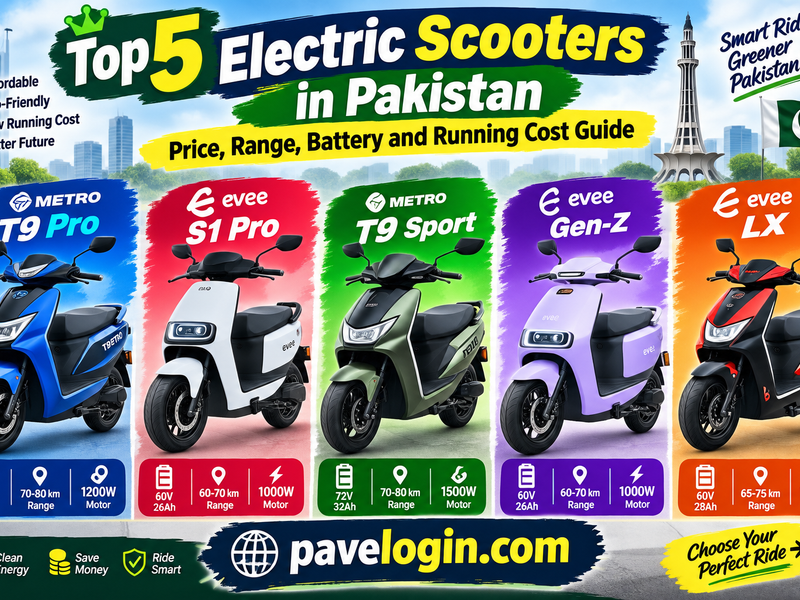
Also Read More About: Top 5 Electric Scooters in Pakistan 2026 Price and Specifications
The trade-off is that an LFP battery can require more physical space or add weight for the same nominal energy capacity.
For an electric-bike buyer, this means battery chemistry should be considered alongside the vehicle’s overall design rather than viewed in isolation.
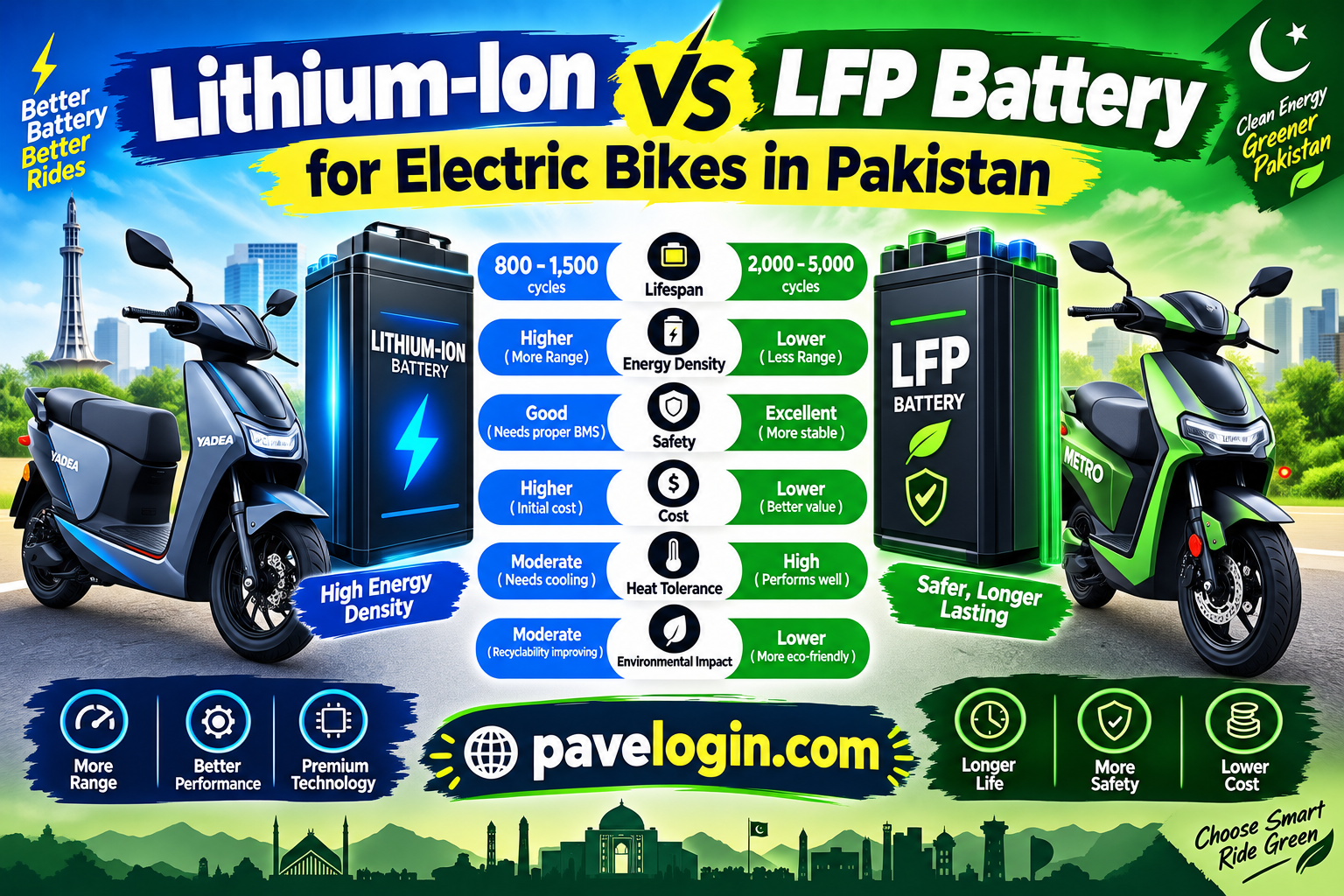
Lithium-Ion vs LFP Battery Comparison
| Feature | Lithium-Ion | LFP |
|---|---|---|
| Energy density | Generally higher | Generally lower |
| Weight for similar capacity | Usually lower | Usually higher |
| Cycle-life potential | Depends heavily on chemistry and usage | Often high |
| Thermal stability | Varies by chemistry and pack design | Generally strong |
| Charging behavior | Depends on cell and BMS | Depends on cell and BMS |
| Space requirement | Often more compact | Can be larger for equivalent energy |
| Suitable applications | Lightweight scooters and bikes | Long-term use and applications prioritizing cycle life |
| Replacement cost | Depends on battery size and chemistry | Depends on battery size and manufacturer |
| Best comparison method | Look at the complete battery specification | Look at the complete battery specification |
There is no single specification that determines battery quality. Cell chemistry, BMS, charger, thermal management, enclosure, manufacturing quality and warranty all matter.
How Does Pakistan’s Heat Affect EV Batteries?
Temperature is an important consideration for any rechargeable lithium battery.
Pakistan experiences very hot summer conditions in many regions. High ambient temperatures can increase battery temperature during charging and riding, particularly when a vehicle is parked in direct sunlight or operated under heavy load.
However, it would be misleading to say that every lithium-ion battery is unsafe in Pakistani summers or that an LFP battery cannot be affected by heat.
The more useful question is:
How well is the complete battery pack designed to operate under the expected temperature conditions?
This depends on:
- Cell chemistry
- Battery-management system
- Thermal design
- Battery enclosure
- Charger configuration
- Charging environment
- Vehicle load
- Riding conditions
- Manufacturer specifications
Always check the manufacturer’s stated charging and operating temperature limits for the specific battery.
LFP Battery and Thermal Stability
LFP chemistry is generally recognized for good thermal stability compared with some other lithium-ion chemistries.
That characteristic can be useful in electric vehicles, but it does not mean an LFP battery is immune to overheating.
An LFP pack can still be damaged by:
- Excessive heat
- Incorrect charging
- Physical damage
- Poor-quality cells
- Faulty wiring
- Improper battery modifications
- A poorly designed charging system
The Battery Management System (BMS) is therefore an important part of the overall battery system.
Rather than choosing a battery solely because it is LFP, buyers should ask about the cell manufacturer, BMS, charger and warranty.
Lithium-Ion Battery and Heat Management
Lithium-ion batteries also require appropriate temperature management.
High temperatures can accelerate battery aging, while charging a battery outside its specified temperature range can increase the risk of damage.
For everyday use, simple precautions can help:
- Avoid leaving the bike in direct sunlight for long periods.
- Allow a very hot battery to cool before charging if the manufacturer’s instructions require it.
- Use the original or manufacturer-approved charger.
- Do not modify the battery pack without professional support.
- Keep charging equipment dry and in good condition.
- Follow the manufacturer’s temperature and charging instructions.
These precautions are relevant regardless of whether the battery is conventional lithium-ion or LFP.
Does LFP Have a Longer Battery Life?
LFP batteries can have a high cycle-life potential, and this is one of their major technical advantages.
However, claims such as “every LFP battery lasts 3,000 cycles” or “every LFP battery will last 10 years” are too broad.
Battery life depends on how the battery is used.
Important factors include:
- Depth of discharge
- Charging frequency
- Charging temperature
- Storage temperature
- Cell quality
- BMS configuration
- Average load
- Charging voltage
- Time spent at very high or very low state of charge
- Overall battery construction
A manufacturer’s cycle-life figure should therefore be read together with its testing conditions.
Understanding Battery Cycle Life
A battery cycle is generally related to the equivalent of using a full portion of the battery’s capacity and recharging it.
For example, using 50% of a battery’s capacity and then charging it does not necessarily represent the same amount of battery usage as repeatedly using 100% of its capacity.
This is why cycle-life figures should not automatically be converted into a fixed number of years.
For example, if a battery has a theoretical cycle rating of 2,000 cycles, its actual service life depends on how those cycles are accumulated and the conditions under which the battery operates.
Lithium-Ion vs LFP: Which Has Better Value?
Initial purchase price is only one part of EV ownership cost.
A better calculation considers:
Total battery cost = Purchase price + charging cost + maintenance + eventual replacement cost
A battery with a higher purchase price could make financial sense if it provides a longer useful service life. On the other hand, a cheaper battery may be appropriate for a rider who plans to use the vehicle for a shorter period.
The correct comparison therefore depends on the buyer’s expected ownership period.
Battery Weight and Electric Bike Performance
Battery chemistry also affects vehicle weight.
For similar energy capacity, LFP batteries can be heavier than some high-energy-density lithium-ion configurations.
Additional weight can influence:
- Acceleration
- Handling
- Energy consumption
- Braking
- Ease of moving the bike manually
- Range
This can be particularly noticeable on lightweight commuter bikes.
At the same time, a lighter battery is not automatically better. A buyer must balance weight against capacity, cycle life, durability and the intended use of the vehicle.
Battery Size: Voltage and Amp-Hours Explained
Electric-bike batteries are commonly described using voltage (V) and amp-hours (Ah).
A simplified energy calculation is:
Battery energy (Wh) = Voltage × Amp-hours
For example:
60V × 30Ah = 1,800Wh
That equals approximately:
1.8 kWh
This is the battery’s nominal energy capacity. Actual energy available for riding can be different because of operating conditions, battery-management limits and conversion losses.
This calculation is useful when comparing different electric-bike batteries.
How Much Electricity Does an LFP Battery Use?
Consider a hypothetical 60V 30Ah battery:
60 × 30 = 1,800Wh
or:
1.8 kWh
If electricity costs PKR 60 per kWh, the theoretical battery-energy cost would be:
1.8 × 60 = PKR 108
However, electricity drawn from the wall can be higher because chargers and charging systems have losses.
Therefore, the actual charging cost should be measured from the electricity meter or estimated using the charger and charging efficiency.
A fixed claim such as “every 60V 30Ah battery costs exactly PKR 108 to charge” would not be accurate.
How to Calculate Electric Bike Running Cost
You can estimate your own electricity cost using:
Monthly charging cost = Monthly kilometers × Energy consumption per kilometer × Electricity tariff
For example, if an electric bike consumes an average of 0.03 kWh per kilometer and the rider travels 800 km per month:
800 × 0.03 = 24 kWh
At PKR 60 per kWh:
24 × 60 = PKR 1,440
This is an illustrative calculation, not a universal EV running cost.
Actual consumption can change because of rider weight, speed, road conditions, battery age, tire pressure and temperature.
Can You Replace a Lithium-Ion Battery With LFP?
Not automatically.
An electric bike should not be converted to another battery chemistry simply because the voltage appears similar.
Before replacing a battery, the following must be checked:
- Battery voltage
- Battery capacity
- BMS compatibility
- Charger compatibility
- Controller specifications
- Physical dimensions
- Battery connectors
- Current requirements
- Mounting system
- Manufacturer requirements
For example, two battery packs can both be labeled “60V” but still require different charging equipment or BMS configurations.
Battery replacement should therefore be handled by a qualified technician or the vehicle manufacturer.
Why Battery Management System (BMS) Matters
The BMS is one of the most important components of a modern lithium battery pack.
Depending on the system, the BMS can monitor and manage factors such as:
- Cell voltage
- Pack voltage
- Charging conditions
- Discharge current
- Temperature
- Cell balancing
- Protection against certain electrical faults
A good battery chemistry cannot compensate for poor pack construction or unsuitable electronics.
When comparing electric bikes, ask whether the manufacturer provides information about the BMS and battery protection system.
REVOO Electric Bikes: What Should Buyers Check?
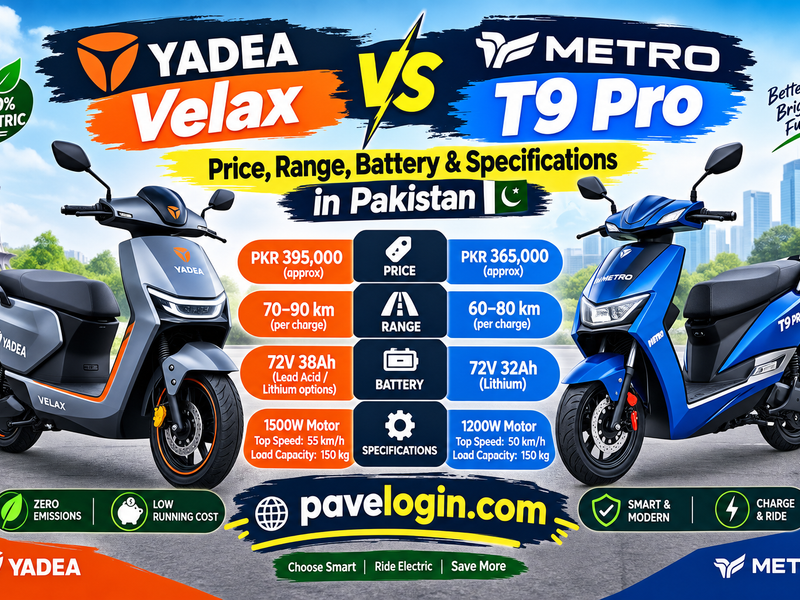
Some electric-bike manufacturers, including REVOO, offer different battery configurations across their model lineup.
If a particular model is available with both conventional lithium-ion and LFP options, compare the actual battery specifications of the variants rather than assuming that one chemistry automatically provides a certain range or lifespan.
For models such as the REVOO A11 or A12, buyers should confirm:
- Battery chemistry
- Battery capacity
- Warranty duration
- Charging time
- Claimed range
- Battery replacement price
- Available service centers
The same principle applies to higher-performance models such as the REVOO E52. Motor power, battery voltage, battery capacity and chemistry should be evaluated together.
Battery Warranty Is More Important Than a Marketing Claim
A battery warranty can provide useful information about the manufacturer’s confidence in its product, but warranty terms vary.
Before buying an electric bike, request the written warranty and check:
- Warranty duration
- Mileage limit
- What battery failures are covered
- Whether capacity degradation is covered
- Conditions for warranty claims
- Physical-damage exclusions
- Charging-related exclusions
- Replacement procedure
- Availability of replacement batteries
Do not assume that a stated “24-month” or “36-month” warranty means the manufacturer will replace the battery under every circumstance.
Lithium-Ion vs LFP for Different Riders
LFP may be worth considering if you:
- Plan to keep the electric bike for several years
- Prioritize cycle-life potential
- Regularly use the bike for commuting
- Want a battery chemistry known for good thermal stability
- Do not mind additional battery weight
- Have suitable charging arrangements
Lithium-ion may be worth considering if you:
- Prioritize a lighter vehicle
- Want higher energy density
- Prefer a compact battery design
- Frequently move the bike manually
- Are buying a lightweight commuter model
- Have a high-quality battery pack with an appropriate BMS
These are general considerations rather than a universal recommendation.
Common Mistakes When Buying an EV Battery
1. Looking only at battery chemistry
“Lithium” or “LFP” does not tell you everything about the battery.
2. Comparing only Ah
A 30Ah battery at 72V contains considerably more nominal energy than a 30Ah battery at 48V.
Always consider:
Voltage × Ah = nominal Wh
3. Believing maximum range figures
Advertised range is usually dependent on test conditions. Real-world range can be lower.
4. Ignoring replacement cost
A battery is one of the most expensive components of many electric vehicles.
5. Ignoring the warranty
Always read the written battery warranty before purchase.
6. Using an incompatible charger
The charger should match the battery and manufacturer’s specifications.
7. Modifying the battery without professional support
Changing cells, BMS or wiring can create compatibility and safety problems.
Lithium-Ion vs LFP: Which One Should You Choose?
There is no universal winner between Lithium-ion and LFP batteries.
LFP offers characteristics such as strong thermal stability and high cycle-life potential, which can be attractive for riders planning long-term ownership.
Lithium-ion configurations can offer higher energy density and lower weight, making them useful for lightweight electric bikes where portability and compact design are important.
For buyers in Pakistan, the most useful approach is to compare the complete battery system, not just its chemistry.
Before making a purchase, compare:
- Battery chemistry
- Voltage and Ah
- Nominal kWh
- Actual vehicle range
- Battery weight
- Charging time
- BMS
- Charger
- Warranty
- Replacement cost
- Local service availability
The best battery for a particular rider is the one whose specifications match that rider’s daily distance, charging conditions, budget and expected ownership period.
Frequently Asked Questions
Is LFP better than Lithium-ion for electric bikes?
LFP has advantages such as high cycle-life potential and good thermal stability, while many lithium-ion chemistries offer higher energy density and lower weight. The appropriate option depends on the vehicle and the rider’s requirements.
Does LFP battery last longer?
LFP batteries can offer a high number of charge cycles, but actual service life depends on the cells, BMS, charging conditions, temperature and usage pattern. A cycle rating should not be treated as a guaranteed number of years.
Is LFP safer in hot weather?
LFP chemistry generally has good thermal stability, but no lithium battery should be exposed to conditions outside its manufacturer’s specified operating and charging limits.
Can an electric bike use either LFP or Lithium-ion batteries?
Not necessarily. The battery, BMS, charger, controller, voltage and physical mounting system must all be compatible.
Does LFP increase electric-bike weight?
It can. For an equivalent energy capacity, an LFP pack may be heavier than a higher-energy-density lithium-ion configuration.
How do I calculate an EV battery’s capacity?
Use:
Battery capacity in Wh = Voltage × Ah
For example, a 60V 30Ah battery has a nominal capacity of approximately 1,800Wh or 1.8kWh.
How much does an electric bike cost to charge?
It depends on battery capacity, electricity tariff and charging losses. Calculate the approximate energy required in kWh and multiply it by your electricity rate.
Final Takeaway
Choosing between Lithium-ion and LFP is ultimately a question of trade-offs rather than a simple “better battery” decision.
LFP can be attractive for riders who prioritize cycle-life potential and thermal stability, while Lithium-ion can be useful where low weight, compact dimensions and energy density are important.
For Pakistan’s market, buyers should pay particular attention to the quality of the complete battery pack, BMS, charger, warranty, replacement cost and local after-sales support.
Most importantly, do not purchase an electric bike based solely on a battery label or an advertised range figure. Compare the complete specifications and calculate how the vehicle fits your actual daily travel requirements.
That approach can help you make a more informed EV purchase and avoid unexpected battery and ownership costs later.