High-speed electric scooters are becoming an increasingly visible option for daily commuting in Pakistan. Rising fuel expenses, routine maintenance requirements and growing interest in lower-cost urban transportation have encouraged many riders to consider electric alternatives.
However, choosing an electric scooter should involve more than looking at motor wattage or advertised range. Battery chemistry, usable battery capacity, charging time, rider weight, road conditions, after-sales service and the actual electricity tariff all influence the ownership experience.
This guide explains what to look for when buying a high-speed electric scooter in Pakistan, how motor power affects performance, how graphene and lithium batteries differ, and how to calculate your monthly running cost without relying on unrealistic savings claims.
What Is a High-Speed Electric Scooter?
There is no single universal wattage or speed threshold that makes an electric scooter “high-speed.” The term is generally used in the local market for electric scooters capable of higher road speeds than basic low-speed commuter models.
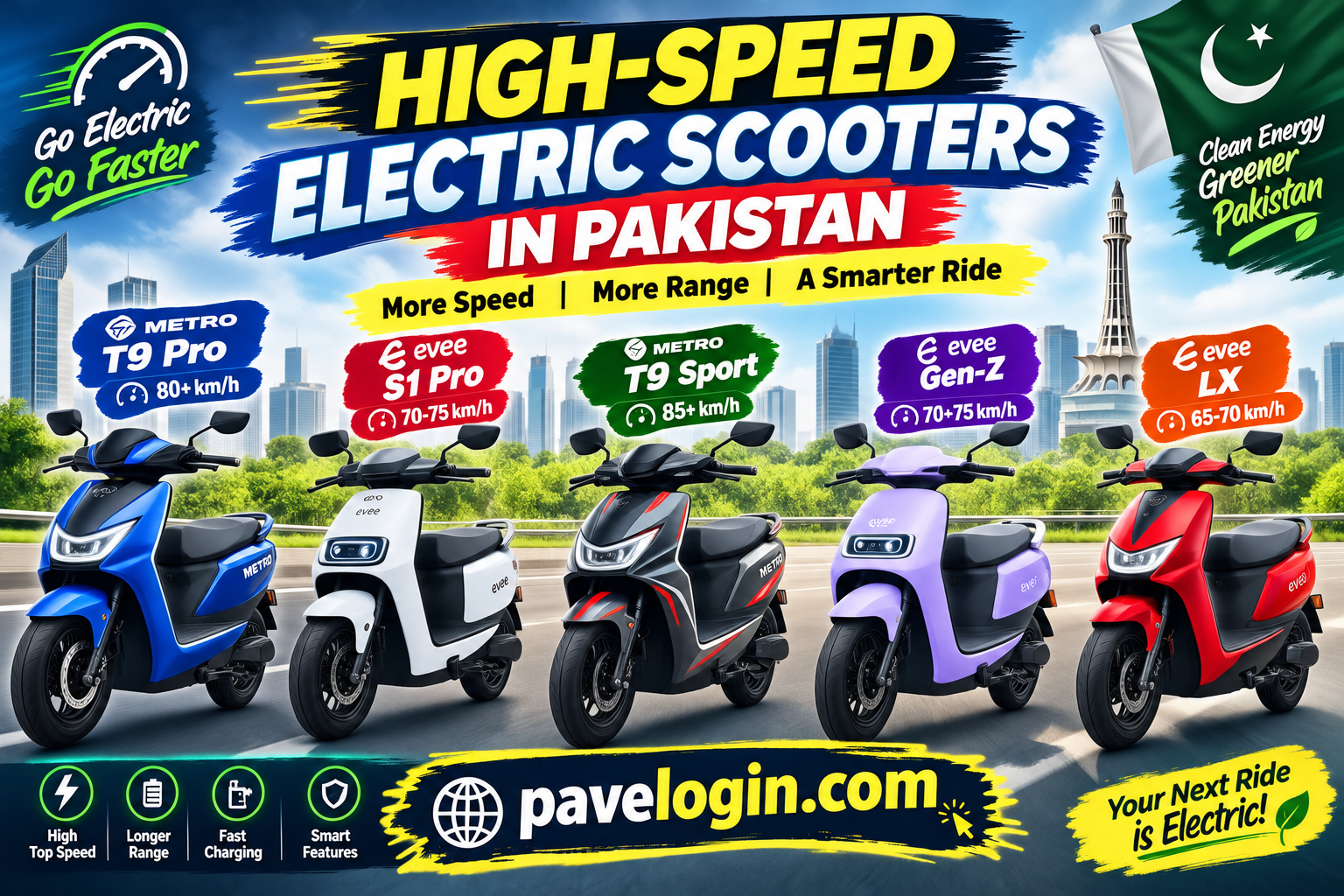
Scooters with motors around 1000W, 1500W or 2000W and above are commonly marketed toward riders who need stronger acceleration and higher cruising speeds.
Motor wattage alone, however, does not determine performance.
Actual performance also depends on:
- Battery voltage
- Controller configuration
- Motor design
- Rider and passenger weight
- Wheel and tyre size
- Road gradient
- Wind resistance
- Battery state of charge
- Manufacturer’s speed settings
- Overall vehicle weight
For this reason, two scooters with the same motor rating can deliver noticeably different riding experiences.
Electric Scooter Motor Power and Expected Speed
Motor ratings are useful for comparing models, but advertised top speed should always be treated as a reference figure rather than a guarantee.
| Motor Rating | Typical Market Speed Range* | Suitable Use |
|---|---|---|
| 1000W | Around 40–50 km/h | City commuting and residential routes |
| 1500W | Around 50–65 km/h | Longer urban commutes and moderate traffic |
| 2000W+ | Around 60–85+ km/h | Higher-performance commuting, subject to model design |
*Actual speed varies by model, controller, battery voltage, rider load and road conditions.
Does Higher Wattage Always Mean Higher Speed?
Not necessarily.
A higher-powered motor can provide greater torque and stronger acceleration, particularly when starting from a stop or climbing an incline. But top speed is also affected by battery voltage, controller limits, gearing or motor characteristics, aerodynamics and vehicle design.
Therefore, buyers should not select a scooter based solely on the largest wattage number printed in a specification sheet.
Battery Options for Electric Scooters in Pakistan
The battery is one of the most important components of an electric scooter because it affects range, weight, charging requirements, purchase price and long-term ownership cost.
Two broad battery categories commonly appear in the Pakistani electric two-wheeler market: lead-acid-derived batteries marketed under names such as graphene, and lithium-based battery systems.
1. Graphene or Lead-Acid-Derived Batteries
Many electric scooters are sold with battery packs described as graphene batteries.
In practical terms, these are generally related to lead-acid battery technology rather than being equivalent to a lithium battery simply because the word “graphene” appears in the product description.
Potential advantages include:
- Lower initial purchase cost
- Familiar battery technology
- Availability in many local electric two-wheeler models
- Relatively straightforward replacement options in some markets
Potential disadvantages include:
- Higher battery weight
- Greater impact on overall vehicle weight
- Different charging characteristics from lithium systems
- Potentially shorter useful service life depending on battery quality and usage
Buyers should ask the dealer for the exact battery chemistry, voltage, Ah capacity and warranty terms instead of relying only on the marketing name.
2. Lithium-Ion and LFP Batteries
Lithium-ion batteries are generally lighter than comparable lead-acid-based packs and can offer a better energy-to-weight ratio.
LFP, or lithium iron phosphate, is one specific lithium battery chemistry. It is different from other lithium-ion chemistries such as NMC.
Potential advantages of lithium systems include:
- Lower battery weight
- High energy density
- Good usable energy for the vehicle’s weight
- More convenient packaging
- Availability of removable battery designs in some models
The actual quality of a lithium battery depends heavily on its cells, battery-management system (BMS), thermal design, charger and manufacturing quality.
Graphene vs Lithium: Quick Comparison
| Feature | Graphene/Lead-Acid-Based | Lithium / LFP |
|---|---|---|
| Initial cost | Usually lower | Usually higher |
| Weight | Higher | Lower |
| Energy density | Lower | Higher |
| Vehicle weight impact | Greater | Lower |
| Charging characteristics | Model-dependent | Model-dependent |
| Replacement cost | Can be lower | Usually higher |
| Long-term performance | Depends on battery quality and use | Depends on chemistry, cells and BMS |
There is no universal battery choice for every rider. The right option depends on budget, daily mileage, charging access and expected ownership period.
How to Calculate Electric Scooter Battery Capacity
Battery capacity can be estimated using a simple formula:
Battery Energy (Wh) = Voltage (V) × Capacity (Ah)
For example:
A 72V 30Ah battery has a nominal energy rating of:
72 × 30 = 2,160 Wh
or approximately:
2.16 kWh
This is the battery’s nominal stored energy. It should not automatically be interpreted as the exact electricity drawn from the household meter because charging losses, battery-management systems and charger efficiency also affect electricity consumption.
Electric Scooter Running Cost in Pakistan
One of the biggest reasons people consider electric scooters is the potential difference between electricity and petrol energy costs.
However, the actual saving depends on the rider’s mileage, petrol price, electricity tariff and scooter efficiency.
Instead of using a fixed “guaranteed saving,” it is better to calculate the cost for your own usage.
Example: 1,200 km Monthly Commute
Suppose a petrol motorcycle achieves approximately 42 km per litre.
For 1,200 km:
1,200 ÷ 42 = approximately 28.6 litres
If petrol costs Rs. 310 per litre as an illustrative assumption:
28.6 × Rs. 310 ≈ Rs. 8,866
Read More About: EV 125 Electric Scooter Review Battery Motor and Riding Experience
This is only a calculation example. Petrol prices change, so the actual monthly cost should be recalculated using the current price.
Calculating Electric Scooter Charging Cost
Suppose an electric scooter has a nominal battery capacity of approximately 2.16 kWh.
If a full charge consumes about 2.4 kWh from the wall after charging losses, and the effective electricity cost is assumed to be Rs. 50 per kWh, the approximate charging cost would be:
2.4 × Rs. 50 = Rs. 120 per full charge
If the scooter realistically travels 80 km per charge:
Rs. 120 ÷ 80 = Rs. 1.50 per km
For 1,200 km:
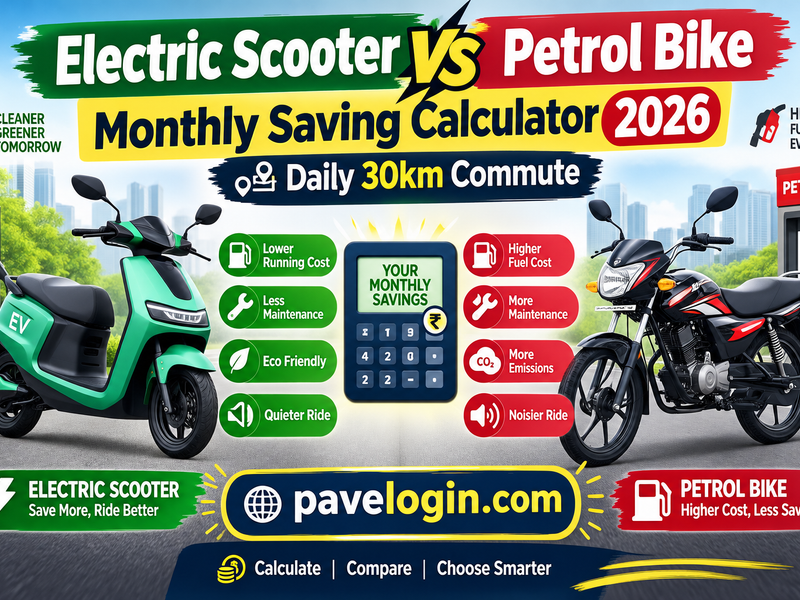
1,200 × Rs. 1.50 = Rs. 1,800 per month
Again, this is an illustrative calculation, not a guaranteed electricity bill.
Actual electricity costs can vary considerably because household tariffs may include different consumption slabs, adjustments, taxes and other charges.
A More Useful Formula
EV Cost per km = Electricity Used per km × Effective Electricity Rate
And:
Monthly Charging Cost = Monthly Kilometres × EV Cost per km
This approach is more reliable than assuming every electric scooter costs the same amount to charge.
Don’t Compare Energy Cost Alone
A petrol motorcycle and electric scooter have different maintenance requirements.
A petrol motorcycle may require:
- Engine oil
- Oil filters where applicable
- Spark plug maintenance
- Air-filter servicing
- Chain and sprocket maintenance
- Clutch-related servicing
- Engine-related repairs
An electric scooter does not have an internal combustion engine, but it is not maintenance-free.
Electric scooter owners may still need to maintain:
- Brake pads or shoes
- Tyres
- Wheel bearings
- Suspension components
- Electrical connections
- Charger
- Controller
- Motor
- Battery
- Lights and switches
Therefore, a proper ownership comparison should include energy + maintenance + battery replacement risk + purchase price, rather than electricity versus petrol alone.
High-Speed Electric Scooter Prices in Pakistan
Prices vary significantly according to motor output, battery chemistry, battery capacity, equipment and brand.
As a general market-reference framework, high-speed electric scooters may fall into several price bands:
| Category | Approximate Market Reference |
|---|---|
| Entry-level 1000W–1500W | Rs. 165,000–235,000 |
| Mid-range 1500W models | Rs. 245,000–315,000 |
| Premium 2000W+ models | Rs. 340,000–440,000+ |
These figures should not be treated as fixed 2026 prices. Dealer promotions, battery configuration, city, warranty package and model-year changes can alter the final price.
Before purchasing, ask the dealer for a written quotation showing:
- Scooter price
- Battery type
- Battery capacity
- Charger
- Registration-related charges
- Warranty
- Delivery charges
- Accessories
- After-sales service terms
High-Speed Electric Scooter: Advantages
Lower Energy Cost Potential
Electricity can cost less per kilometre than petrol under many usage conditions, particularly for riders who travel long distances regularly.
The actual difference depends on the vehicle’s efficiency and the rider’s electricity tariff.
Less Routine Mechanical Maintenance
Because an electric scooter does not use an internal combustion engine, it eliminates engine oil changes and several engine-specific maintenance jobs.
However, normal vehicle maintenance is still required.
Quiet Operation
Electric motors generally produce less mechanical noise than petrol engines. This can make urban commuting quieter and may provide a smoother riding experience.
Strong Low-Speed Torque
Electric motors can provide useful torque from low speeds, which can make acceleration from a stop feel responsive.
The exact acceleration depends on the motor, controller, battery and vehicle setup.
Limitations to Consider Before Buying
Electric scooters also have practical limitations that should not be ignored.
Charging Takes Longer Than Refuelling
Petrol motorcycles can usually be refuelled within minutes. An electric scooter may require several hours depending on battery size and charger output.
Range Depends on Riding Conditions
Manufacturer range figures are not necessarily equal to real-world range.
Range can be affected by:
- Rider weight
- Passenger weight
- Speed
- Road gradient
- Wind
- Tyre pressure
- Battery age
- Temperature
- Stop-and-go traffic
- Use of headlights and other electrical equipment
Battery Replacement Can Be Expensive
The battery is one of the most expensive components of many electric scooters.
Before buying, ask for the current replacement-battery price and warranty rather than focusing only on the scooter’s purchase price.
How to Improve Electric Scooter Range
There are several practical ways to reduce unnecessary energy consumption:
- Maintain recommended tyre pressure.
- Avoid unnecessary high-speed riding.
- Accelerate smoothly instead of repeatedly using maximum throttle.
- Keep the scooter properly serviced.
- Avoid carrying unnecessary weight.
- Plan charging around your daily distance.
- Use the manufacturer’s recommended charger.
- Monitor unusual battery or range changes.
Riding continuously at maximum speed can reduce range because aerodynamic resistance increases rapidly with speed.
Therefore, the advertised maximum range should be viewed as a reference rather than a guaranteed distance.
Electric Scooter Charging and Battery Care
Battery-care advice should always follow the manufacturer’s instructions because different battery chemistries and battery-management systems have different requirements.
General precautions include:
- Use the original or manufacturer-approved charger.
- Avoid using damaged charging equipment.
- Keep charging connectors dry and clean.
- Do not expose the battery to unnecessary extreme heat.
- Avoid storing the vehicle for long periods with an almost empty battery.
- Follow the manufacturer’s recommended charging procedure.
- Have unusual battery heating, swelling or electrical faults inspected by a qualified technician.
There is no need to apply one universal charging percentage rule to every battery. The correct charging practice depends on the battery chemistry and manufacturer’s BMS and charging specifications.
Brakes and Tyres Matter on High-Speed Models
A high-speed electric scooter needs an appropriate braking and tyre setup.
Before purchasing, check:
- Front brake type
- Rear brake type
- Brake size
- Tyre dimensions
- Tyre availability
- Suspension design
- Replacement brake-part availability
Heavier battery packs can increase the overall vehicle weight, so braking performance and tyre condition are important parts of routine maintenance.
For any scooter capable of higher road speeds, riders should also use appropriate protective equipment and follow applicable traffic rules.
Registration and Legal Requirements in Pakistan
Electric-vehicle rules and registration procedures can differ by jurisdiction and can change over time.
For example, Punjab Excise currently publishes specific registration and motor-vehicle-tax provisions for electric vehicles. This does not mean that every electric scooter in every part of Pakistan automatically has identical registration, licensing or road-use requirements.
Before purchasing, confirm the latest requirements with the relevant provincial or territorial Excise and Taxation authority.
Check specifically:
- Whether the vehicle requires registration
- Required documents
- Number-plate requirements
- Applicable registration fees
- Driving-licence requirements
- Local road-use rules
- Insurance requirements, where applicable
Do not rely solely on a dealer’s statement that a particular electric scooter is “registration-free” or automatically legal on every road.
How to Choose the Right High-Speed Electric Scooter
Instead of selecting a scooter only because it has the highest advertised speed, evaluate it using the following checklist.
1. Calculate Your Daily Distance
If your daily commute is 40 km, a scooter with a comfortable real-world range above that figure gives you more flexibility than one whose advertised range is only slightly higher.
2. Check Battery Capacity
Compare both voltage and Ah.
For example:
72V × 30Ah = 2.16 kWh
A larger nominal battery may provide more energy, but vehicle efficiency still determines how far that energy takes you.
3. Compare Battery Chemistry
Ask whether the pack is:
- Lead-acid
- Graphene/lead-acid-derived
- NMC lithium-ion
- LFP
- Another chemistry
Also ask about the BMS.
4. Check Warranty
Do not assume the entire scooter and battery have the same warranty.
Ask separately about:
- Battery warranty
- Motor warranty
- Controller warranty
- Charger warranty
- Frame warranty
- Labour coverage
5. Investigate After-Sales Support
A lower purchase price may not be useful if replacement parts are difficult to obtain.
Ask whether the dealer stocks:
- Batteries
- Chargers
- Controllers
- Brake components
- Tyres
- Body panels
- Electrical components
6. Calculate Total Ownership Cost
A useful ownership calculation is:
Total Cost = Purchase Price + Electricity + Maintenance + Battery Replacement Reserve + Registration/Other Costs
This provides a more realistic comparison than simply comparing petrol and electricity.
Frequently Asked Questions
Are high-speed electric scooters suitable for daily commuting in Pakistan?
They can be suitable for daily commuting when the scooter’s real-world range, charging time, road conditions, load capacity and after-sales support match the rider’s requirements.
Can a high-speed electric scooter be charged at home?
Many models are designed for domestic charging, but buyers should confirm the charger’s input requirements and electrical specifications before purchase.
A standard household socket does not automatically mean that every charger or electrical installation is suitable under all conditions.
Does high-speed riding reduce electric scooter range?
Yes. Higher speeds generally increase energy consumption because aerodynamic drag rises with speed. Frequent hard acceleration, heavy loads, hills and low tyre pressure can also reduce range.
Is a 2000W electric scooter always faster than a 1500W model?
No. Motor wattage alone does not determine top speed. Battery voltage, controller settings, motor design, vehicle weight and other factors also matter.
Are graphene batteries the same as lithium batteries?
No. The term “graphene battery” is commonly used in the electric two-wheeler market for certain lead-acid-based battery products. Buyers should confirm the exact chemistry from the manufacturer.
How long does an electric scooter battery last?
There is no single lifespan that applies to every battery. Service life depends on chemistry, cell quality, temperature, charging habits, depth of discharge, usage frequency and battery-management-system quality.
Instead of relying on a fixed number of years, check the manufacturer’s warranty and expected cycle-life information for the specific battery.
Is an electric scooter completely maintenance-free?
No. Electric scooters eliminate many engine-related maintenance tasks, but tyres, brakes, suspension, bearings, electrical components, chargers and batteries still require inspection and maintenance.
Is an electric scooter always cheaper than a petrol motorcycle?
Not necessarily.
Electric scooters can have lower energy and some maintenance costs, but the purchase price, battery replacement cost, electricity tariff and annual mileage all affect total ownership cost.
Final Buying Checklist
Before purchasing a high-speed electric scooter in Pakistan, compare these factors together:
| Factor | What to Check |
|---|---|
| Motor | Rated wattage and controller configuration |
| Battery | Chemistry, voltage and Ah |
| Energy | Nominal kWh capacity |
| Range | Real-world range rather than headline figure |
| Charging | Charger rating and expected charging time |
| Brakes | Front/rear braking system |
| Tyres | Size and local availability |
| Warranty | Separate motor, battery and charger coverage |
| Parts | Availability of replacement components |
| Registration | Current local requirements |
| Price | Complete on-road/purchase cost |
| Running Cost | Electricity + maintenance + battery reserve |
Conclusion
High-speed electric scooters can provide a practical alternative for Pakistani commuters who want to reduce dependence on petrol and simplify some aspects of vehicle maintenance.
The strongest buying decision is not necessarily the scooter with the biggest motor or the longest advertised range. Instead, focus on battery capacity, real-world range, charging convenience, braking hardware, warranty coverage, replacement-parts availability and total ownership cost.
For a meaningful petrol-versus-electric comparison, calculate your own monthly kilometres and use current local petrol and electricity rates. This produces a more realistic estimate than relying on fixed savings percentages or guaranteed payback periods.
As Pakistan’s electric-vehicle market continues to develop, buyers should also verify the latest registration rules, government incentives, dealer pricing and battery specifications before placing an order.