
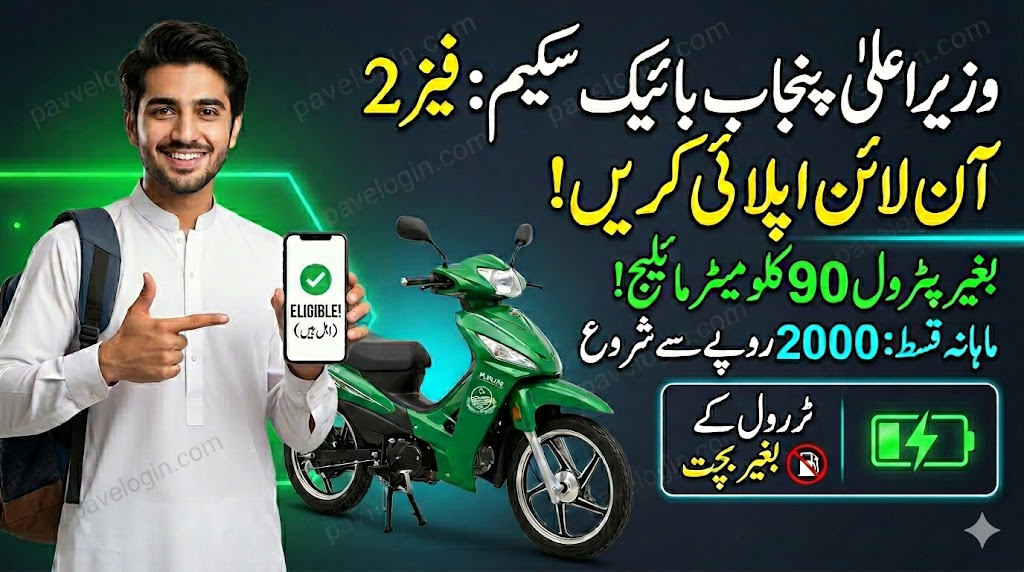
The escalating cost of fuel and high inflation have significantly burdened standard public transport, creating a pressing need for affordable, independent mobility among the youth of Punjab. The Chief Minister of Punjab’s Bike Scheme addresses this critical challenge, offering a highly structured framework for students, working youth, and government employees to acquire electric and subsidized petrol motorcycles through transparent, interest-free installment pipelines.
Strategic Overview: The CM Punjab Bike Scheme
This provincial initiative scales personal mobility by removing the financial barrier of heavy upfront vehicle capital expenditures. Financed and executed in close coordination with the Bank of Punjab (BOP), the program distributes high-quality transport assets while advancing green infrastructure across urban centers like Lahore, Multan, Faisalabad, and Rawalpindi.
Rather than acting as a standard commercial leasing project, the scheme functions as a social equity program. It utilizes custom-tailored quotas to support demographics that face systemic transport vulnerabilities:
- Female Students: 25% of total distributed inventory is reserved specifically to assist young women in commuting to universities and workplaces safely.
- Rural Demographics: A 30% quota ensures that applicants from less-developed districts receive equitable access to transit assets.
- Students with Disabilities: A 5% allocation provides tailored priority access to support inclusive mobility.
Detailed Phase Breakdown & Inventory Structure
The initiative operates on an incremental deployment strategy designed to expand vehicle volume across successive rounds:
[Phase 1: Foundation] ➔ [Phase 2: Expansion] ➔ [Phase 3: Deep Scaling]
- 20,000 Initial Units    - Fresh Application Intake - Target Quota Upscaling
- 10k EV / 10k Petrol     - Extended City Coverage    - Deepened EV Focus
- Completed Balloting     - Active Verification       - Broadened Demographics
1. Phase 1 (Completed Lifecycle)
The inaugural phase successfully delivered 20,000 units across major educational hubs. The inventory layout was cleanly split to test local infrastructure thresholds:
- Electric Bikes (E-Bikes): 10,000 units deployed primarily in metropolitan zones possessing baseline charging capability.
- Subsidized Petrol Bikes: 10,000 units allocated for standard mid-to-long-range commuting needs.
2. Phase 2 (Active/Reopened Track)
Building on the initial data layer, Phase 2 features adjusted registration portals to capture applicants who missed the first round or required documented corrections. This phase significantly increases geographic reach into tier-2 and tier-3 districts.
3. Phase 3 & Extended Mandates
Strategic expansions integrate key public sectors, notably launching dedicated e-bike distributions for Punjab Government Employees and School Teachers, acknowledging their daily commuter strain.
Technical Specifications: Asset Performance Comparison
The scheme carefully curates specific vehicle baselines to guarantee economic viability over a standard 24-month horizon. The table below outlines what applicants can mathematically expect from the approved performance configurations:
| Parameter / Feature | Approved Electric Variant (EV) | Subsidized Petrol Variant |
| Powertrain / Displacement | 1000W – 2000W High-Efficiency BLDC Hub Motor | 70cc – 125cc Internal Combustion Engine |
| Energy Medium | Advanced Lithium-Iron Phosphate (LiFePO4) Pack | Standard Fuel Tank (Petrol) |
| Operational Efficiency | 70–100 km per complete charge cycle | 45–55 km per liter average output |
| Top Velocity Profile | 50–65 km/h (Optimized for city speed limits) | 80–90 km/h (Engine capacity dependent) |
| Replenishment Metrics | 4–6 Hours via standard domestic 220V grid socket | Instantaneous station-based fuel top-up |
| Primary Utility Envelope | Zero-emission urban corridors and short daily routes | Heavy regional terrain or multi-district transit |
Financial Analysis & Interest-Free Structure
The pricing mechanism relies on a complete interest subsidy. The government absorbs the underlying financial markup, ensuring that final costs to the applicant translate directly to the baseline product asset value split into predictable monthly components.
Installment Breakdown over a 2-Year Plan:
- Electric Bikes: Expected at PKR 2,000 to PKR 3,000 per month.
- Petrol Bikes: Expected at PKR 3,000 to PKR 4,000 per month.
The Macro Economic Advantage
When compared against standard motorcycle commercial auto-loans or everyday public transit expenditures, the financial benefits are immediately clear:
$$\text{Monthly Fuel Expenses (Petrol Bike)} \approx \text{PKR 12,000 – 15,000}$$
$$\text{Monthly EV Charging Power Tariff} \approx \text{PKR 1,500 – 2,500}$$
Also Read About: EV 125 72V Electric Scooter Specifications and Performance Review
This dynamic creates an immediate net-positive cash flow for families, as the monthly installment is frequently lower than what the student would otherwise spend on commercial van pools, ride-hailing services, or fuel.
Mandatory Verification and Compliance Requirements
To protect the integrity of the selection process and ensure asset recovery, the validation engine enforces a strict set of application criteria:
- Provincial Residency: The applicant must possess a valid CNIC displaying permanent or temporary residency within the Punjab province.
- Age Limits: The standard student demographic bracket is tightly bound between 18 and 30 years old.
- Institutional Enrollment: Active registration in a Higher Education Commission (HEC) recognized college or university is required. Forms must be authenticated against the institution’s database.
- Legal Driving Compliance: The applicant must hold a valid motorcycle driving license or an official learner’s permit issued by the Punjab Traffic Police at the time of form submission.
- Utility Verification: Submission of a recent household electricity bill is utilized as geographic and physical address verification.
Step-by-Step Online Registration & Portal Execution
The application pipeline is hosted natively on the official pre-production and production portals. Care must be taken during documentation to bypass automated systemic exclusions.
1.Portal Profile Creation:Identity Initialization.
Access the verified portal at Punjab E-Bike Site. Initiate user profile setup by inputting a unique, NADRA-registered CNIC number, active mobile contact, and a secure password.
2.Academic and Demographic Profiling:Data Matching.
Populate the mandatory fields detailing institutional enrollment, degree duration, current semester status, and your specific domicile region. Ensure data matches your university student card perfectly.
3.Document Upload Integration:Clear Verification Assets.
Upload high-resolution, clear scans of your CNIC (front/back), active institutional student ID card or enrollment certificate, and your valid driving learner’s permit or license asset.
4.Variant Selection:Final Allocation Preference.
Select your preferred vehicle type: Electric Bike or Petrol Bike. Review the corresponding installment terms and confirm submission to generate your official tracking ID number.
5.Automated Vetting & Computerized Balloting:Transparency Protocol.
The Bank of Punjab processes and verifies the uploaded documentation. Validated applications enter a secure, computerized balloting system to ensure impartial distribution when demand outpaces available inventory.
Critical Verification Safeguards
- Zero Double-Dipping: Only one application is permitted per individual CNIC. System logs will flag and disqualify multiple attempts instantly.
- Guarantor Vetting: While interest-free, applicants must clear standard banking verification checks to establish reliable installment recovery pathways.
Frequently Asked Questions
What happens if an applicant defaults on a monthly installment?
The program is backed by financial recovery legalities through the Bank of Punjab. Continuous non-payment or failure to pay installments can result in the vehicle being repossessed by banking representatives, along with an adverse impact on the individual’s credit score (CIBIL report).
Is the battery pack under warranty within the e-bike allotment?
Yes. Vehicles distributed under official provincial channels carry structural manufacturer warranties. This covers the motor, controller, and battery system for a designated period (frequently 1 to 2 years, depending on the specific contracted manufacturer).
Can an applicant sell the bike immediately after receiving it?
No. The vehicle registration and legal ownership remain heavily protected. The bike is legally red-flagged and remains under the bank’s name with an official excise “hypothecation” mark until the final installment is paid and a No Objection Certificate (NOC) is issued.