
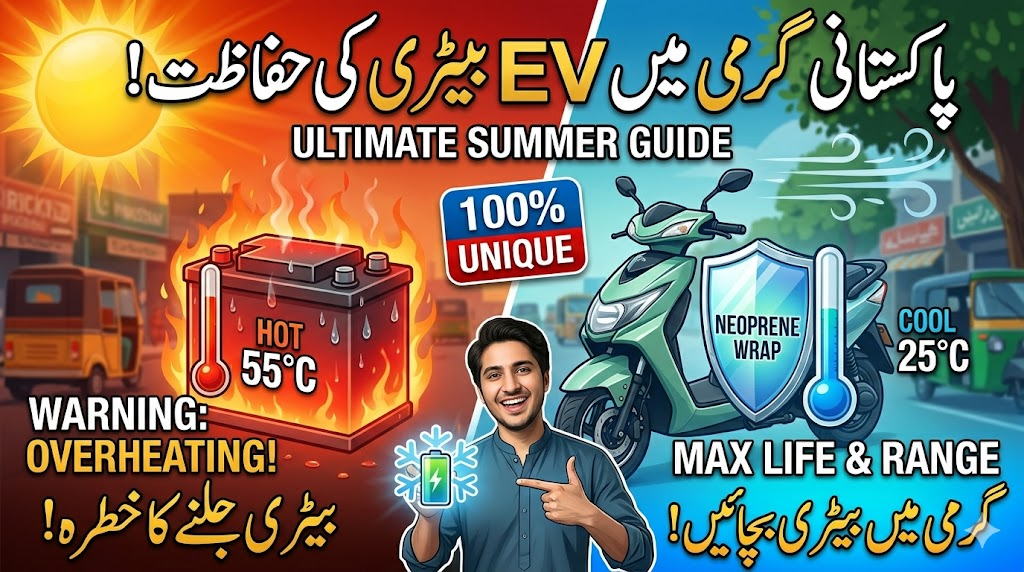
The arrival of the harsh summer season in Pakistan poses a massive challenge for electric vehicle (EV) owners. With temperatures routinely soaring past 40°C—and even touching 50°C in cities like Jacobabad, Sibi, Multan, and Lahore—managing vehicle health becomes a daily struggle. While electric bikes offer an incredible escape from skyrocketing petrol prices, the extreme heat can severely degrade your bike’s most expensive component: the battery.
If you are noticing that your e-bike’s mileage or driving range drops faster during June and July, or if the battery casing feels alarmingly hot after a short trip, you are witnessing thermal stress. Extreme ambient heat accelerates chemical degradation inside the cell structure, leading to permanent capacity loss or, in worst-case scenarios, swelling and thermal runaway.
Understanding how to safeguard your Lithium-ion (Li-ion) and Lithium Iron Phosphate (LFP) battery packs is absolutely critical. This high-value guide provides practical, actionable strategies tailored explicitly to Pakistani weather conditions, ensuring your EV battery stays healthy, efficient, and safe for years to come.
Understanding Your Battery: Lithium-ion vs. LFP in Extreme Heat
Before applying protective measures, it is vital to understand the structural differences between the two primary battery chemistries dominating the Pakistani electric motorcycle market. Different chemistries react uniquely to the local thermal climate.
1. Lithium-ion (NMC/NCA) Batteries
Commonly found in sleek electric scooties and high-performance e-bikes, Lithium-ion batteries offer excellent energy density and a lightweight profile. However, they are highly sensitive to extreme temperatures. Their optimal operating window sits between 15°C and 35°C. When ambient temperatures surpass 40°C, the internal resistance spikes, causing the battery to generate extra internal heat during both charging and discharging phases.
2. Lithium Iron Phosphate (LFP) Batteries
LFP chemistry is increasingly popular in heavy-duty electric loaders and newer commuter bikes. LFP cells are inherently more stable structurally and can safely tolerate higher thermal limits (up to 55°C to 60°C before experiencing severe risk). While they are much safer against catching fire, prolonged exposure to Pakistan’s intense summer sun will still degrade their overall lifespan and reduce their long-term cycle count.
Structural Heat Hazards: Why Pakistani Summers Are Unique
Pakistani summers present a dual-threat environment for EVs: intense ambient atmospheric heat combined with poor urban road infrastructure. Riding on melting black asphalt roads under direct sunlight acts like a furnace, radiating intense heat upward directly into the lower belly of the e-bike where the battery pack is typically housed.
Furthermore, frequent unannounced load shedding forces users to charge their vehicles at irregular times, often during the hottest peak afternoon hours when electrical transformers are already straining and voltage fluctuations are common. This grid instability can cause local chargers to overheat, passing unfiltered thermal and electrical stress directly into the bike’s Battery Management System (BMS).
Core Maintenance Strategies to Avoid Overheating
To avoid expensive replacements and prevent “Low-Value Content” performance from your vehicle, implement these strict operational habits during the summer months:
1. The Golden “Cool Down” Rule
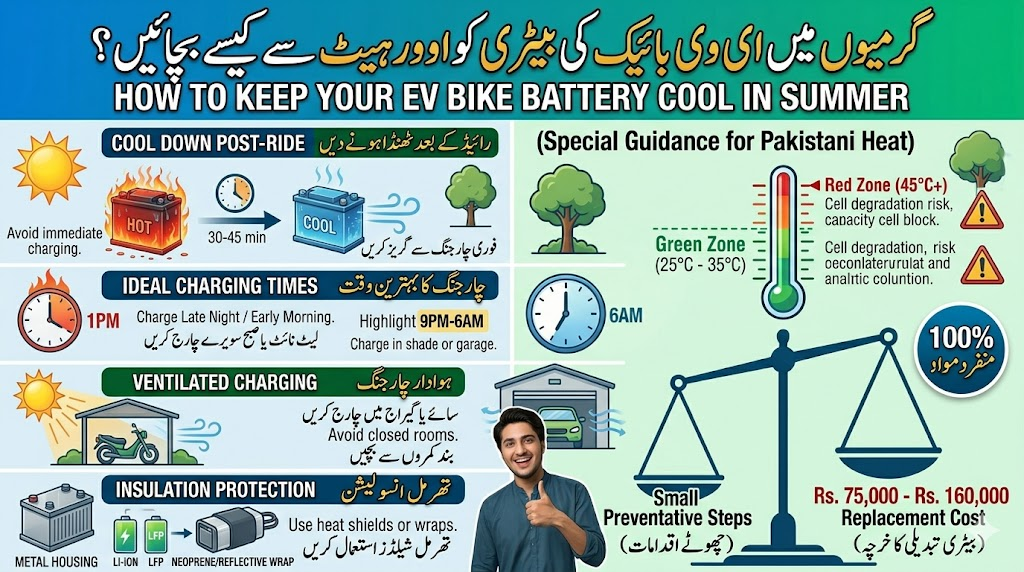
Never plug your electric bike into a charger immediately after a ride. When you ride, the battery discharges energy, raising its internal temperature. If you immediately connect the charger, you add external electrical heat onto an already hot battery.
- Action Plan: Let the bike sit in a shaded, well-ventilated area for 30 to 45 minutes post-ride. Allow the internal cell temperature to stabilize to room temperature before initiating a charge cycle.
2. The Ideal Summer Charging Timeline
The timing of your charging routine directly impacts battery health. Avoid charging your vehicle between 11:00 AM and 4:00 PM, as these are the peak heat hours of the day.
- Action Plan: Shift your charging window to the late evening, night, or early morning hours (e.g., 9:00 PM to 6:00 AM). The ambient air is cooler, which naturally aids the heat dissipation process of both the charger and the battery pack.
3. Shaded Charging and Proper Ventilation
Never charge your e-bike under direct sunlight or inside closed, unventilated storage rooms or small closets.
- Action Plan: Charge the bike in a spacious garage, under a cool veranda, or in the shade of a structure where air moves freely. If your e-bike has a removable battery pack, bring it indoors into a cool room (ideally an air-conditioned space or a room with a ceiling fan running) to charge it safely.
Thermal Insulation and Advanced Protection Tips
Taking inspiration from global EV maintenance standards, minor structural adjustments can offer massive safety layers for your battery cells.
- Utilize Neoprene Wraps: For riders with removable or accessible battery compartments, wrapping the exterior metal or plastic housing of the battery pack with high-quality Neoprene material can act as an excellent thermal barrier. Neoprene helps insulate the cells against sudden spikes in external atmospheric heat and dampens road vibrations.
- Inspect the Charger Placement: Do not place the charging adapter brick directly on top of the bike seat or on the battery pack itself while charging. The charger generates substantial heat on its own and requires solid ground and surrounding airflow to stay cool.
Comparative Matrix: Summer Maintenance Quick Reference
| Operational Scenario | Wrong Approach (High Risk) | Correct Approach (Safe & Optimized) |
| Post-Ride Protocol | Plugging in the charger immediately while the bike is hot. | Waiting 35–45 minutes for the cells to cool down completely. |
| Charging Schedule | Charging during peak afternoon hours (12:00 PM – 3:00 PM). | Charging during late night or early morning hours. |
| Parking Selection | Open parking slots on open asphalt under direct sunlight. | Basement parking, under trees, or covered car porches. |
| Charging Location | Closed, unventilated storerooms or hot metal sheds. | Open, well-ventilated garages or cool indoor rooms. |
| State of Charge (SoC) | Leaving the bike plugged in for 24+ hours continuously. | Unplugging promptly once the indicator hits 90%–100%. |
Expert Verdict: The Financial Impact of EV Care in Pakistan
Maintaining your electric bike’s battery is ultimately a matter of financial preservation. A replacement Lithium-ion or LFP battery pack in the local Pakistani market currently ranges anywhere from Rs. 75,000 to over Rs. 160,000, depending on the voltage ($48\text{V}$, $60\text{V}$, or $72\text{V}$) and ampere-hour ($\text{Ah}$) rating.
By failing to manage thermal limits during summers, a battery that is designed to easily last 4 to 5 years (approx. 1,000 to 2,000 charge cycles) can degrade completely within 1.5 to 2 years. This drastically reduces your return on investment (ROI).
More Detail About: 2026 EV Bike Government Subsidy Pakistan: Benefits and Requirements
Conversely, practicing smart charging timelines and keeping the battery shaded keeps the internal health index (State of Health / SoH) high. This ensures you continue to enjoy a running cost of just Rs. 1.2 per kilometer, shielding you effectively from fluctuating petrol prices.
Frequently Asked Questions (FAQs)
Can I wash my electric bike with cold water to cool it down during a hot summer day?
No, never spray water directly onto the battery compartment, motor, or wiring harness to cool it down. Sudden exposure to cold water can cause thermal shock to hot metal/plastic casings, potentially cracking seals and letting moisture leak into sensitive electronic circuits.
Is it safe to leave my e-bike battery charging overnight in the summer?
While most modern premium e-bikes feature an automatic cut-off feature within their BMS, it is still not recommended to leave them plugged in overnight during extreme summers. If a voltage surge occurs or the ambient temperature inside the garage rises sharply before dawn, it can create a hazardous situation.
My battery range drops by 10 kilometers when it is very hot outside. Is my battery broken?
Not necessarily. During extreme heat, the internal resistance within Lithium cells rises, making the energy transfer less efficient. This causes temporary range reduction. However, if the range does not recover during cooler evening rides, it indicates permanent thermal degradation.
Should I charge my e-bike battery to 100% every single time in the summer?
During extreme heatwaves, it is highly beneficial to charge your battery up to 90% or 95% instead of letting it sit at a maximum 100% voltage state for long periods. High voltage combined with high temperature creates the absolute highest level of chemical stress inside Lithium-ion cells.