For many people in Pakistan, a motorcycle is one of the most practical ways to travel to work, college, markets, and other daily destinations. At the same time, electric scooters are becoming more visible in the local two-wheeler market.
The financial question is straightforward: does an electric scooter actually cost less to operate than a petrol motorcycle?
There is no single answer for every rider because the result depends on daily mileage, fuel economy, petrol prices, electricity tariffs, scooter efficiency, maintenance, and battery costs.
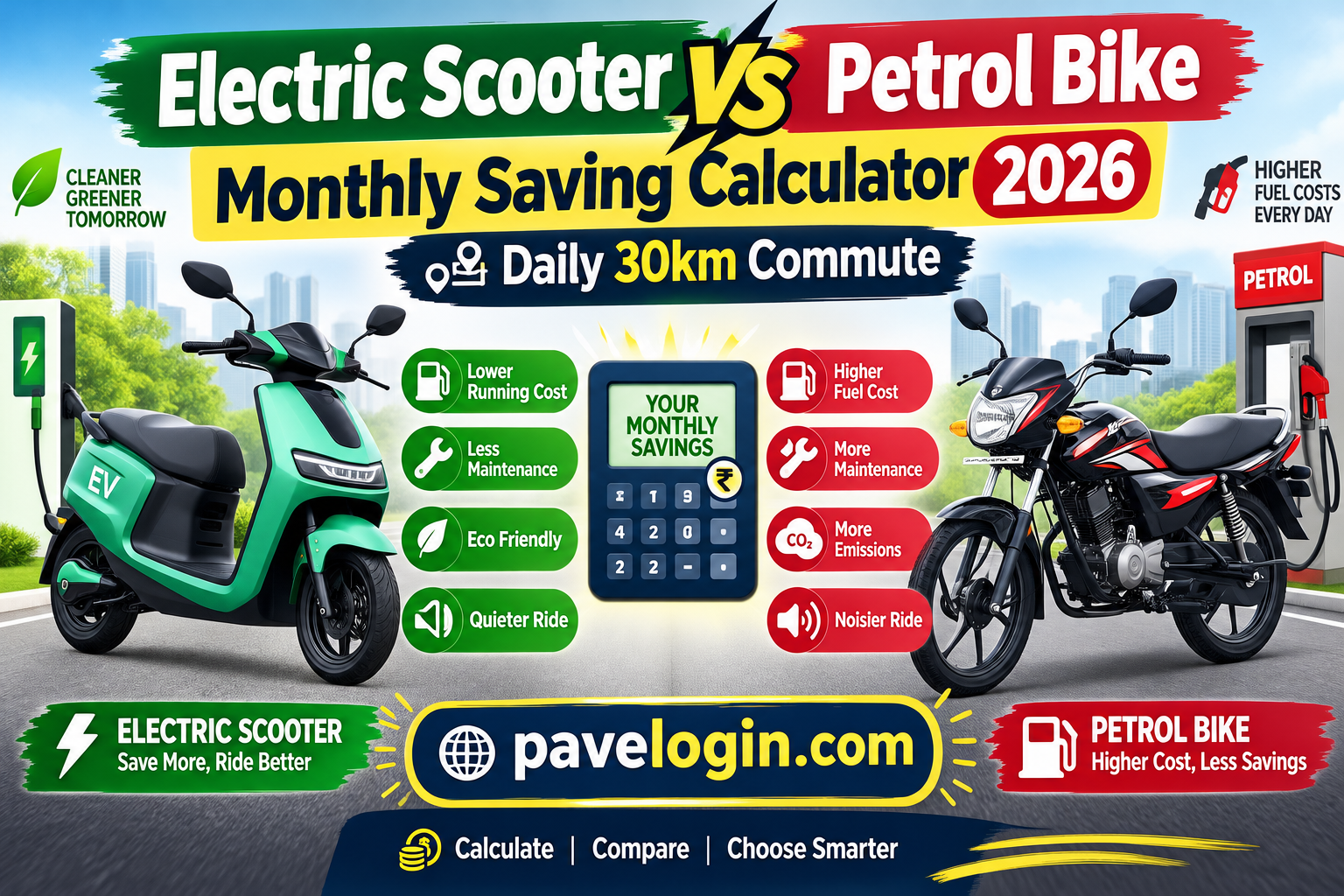
This guide provides a transparent example using a 30 km daily commute for 26 days per month. Instead of presenting the result as a guaranteed saving, the calculations show how you can estimate your own monthly running cost.
Important: The figures below are illustrative assumptions, not a universal 2026 price list. Petrol prices, electricity tariffs, maintenance charges, and vehicle efficiency can change. Replace the example figures with your current local rates for a more accurate calculation.
Petrol Motorcycle Monthly Cost
A petrol motorcycle’s running cost consists primarily of fuel, routine servicing, tyres, chain and sprocket wear, and occasional repairs.
For this example, assume a commuter travels:
- Daily distance: 30 km
- Working days: 26 days per month
- Monthly distance: 780 km
- Example fuel economy: 45 km/L
- Illustrative petrol price: PKR 310/L
The monthly distance is:
30 × 26 = 780 km
Fuel required at 45 km/L:
780 ÷ 45 = 17.33 litres
At an assumed petrol price of PKR 310 per litre:
17.33 × 310 ≈ PKR 5,373
So, under these assumptions, the monthly petrol expense would be approximately PKR 5,373.
This is an example rather than a current guaranteed fuel cost. A motorcycle delivering 55 km/L will require less fuel, while a bike achieving only 35–40 km/L will require more.
Petrol Cost Changes With Fuel Economy
Fuel economy can have a significant effect on the monthly bill.
| Fuel Economy | Fuel Needed for 780 km | Cost at PKR 310/L |
|---|---|---|
| 35 km/L | 22.29 L | PKR 6,910 |
| 40 km/L | 19.50 L | PKR 6,045 |
| 45 km/L | 17.33 L | PKR 5,373 |
| 50 km/L | 15.60 L | PKR 4,836 |
| 55 km/L | 14.18 L | PKR 4,396 |
This table illustrates why using a generic “average motorcycle mileage” can produce misleading comparisons.
Traffic, tyre pressure, rider behaviour, engine condition, road gradients, and passenger load can all influence real-world fuel consumption.
Also Read More About: Fast and Reliable Electric Scooter 2000W ZF70E2000 Specs
Petrol Motorcycle Maintenance Cost
Fuel is not the only operating expense.
A petrol motorcycle has an internal-combustion engine and therefore requires regular maintenance. Typical expenses can include engine oil, air and fuel filters, spark plugs, chain lubrication, chain and sprocket replacement, brake components, tyres, cables, and occasional mechanical repairs.
Instead of assigning an arbitrary fixed monthly maintenance bill, it is more useful to treat maintenance as an annual or kilometer-based cost.
For example, suppose a rider spends PKR 12,000 per year on routine maintenance and wear items.
At 12 months:
PKR 12,000 ÷ 12 = PKR 1,000 per month
This is only an example. Actual maintenance can be considerably different depending on the motorcycle, workshop, mileage, parts quality, and condition of the vehicle.
Possible petrol-bike maintenance items
- Engine oil
- Oil/filter servicing where applicable
- Air filter
- Spark plug
- Chain and sprocket
- Brake pads or shoes
- Tyres
- Cables
- Suspension components
- Unexpected mechanical repairs
A newer motorcycle may require less repair expenditure than an older, heavily used bike.
Electric Scooter Monthly Cost
An electric scooter does not consume petrol. Instead, its main energy expense is electricity.
The correct way to calculate the electricity cost is to determine how much energy the scooter actually uses per kilometer.
Basic formula
Electricity cost per km = kWh consumed per km × electricity tariff
For example, if a scooter uses an average of 0.03 kWh/km and the effective electricity cost is PKR 60 per kWh:
0.03 × 60 = PKR 1.80 per km
For a 780 km monthly commute: 780 × 1.80 = PKR 1,404
This is an example calculation, not a claim that every electric scooter consumes exactly 0.03 kWh/km.
Actual wall-to-wheel consumption can be affected by charging losses, rider weight, speed, battery condition, tyre pressure, temperature, road gradient, and riding style.
Why Battery Capacity Is Not the Same as Running Cost
Electric-scooter specifications often advertise battery voltage and amp-hour capacity.
For example: 72V × 30Ah = 2.16 kWh
This gives the battery’s approximate nominal energy capacity.
However, that number alone does not tell you the cost per kilometer.
Two scooters with similar battery capacities can have different ranges because their motors, controllers, vehicle weights, tyres, aerodynamics, and software settings may differ.
For a cost comparison, measured energy consumption per kilometer is more useful than battery capacity alone.
Electric Scooter Maintenance
Electric scooters generally have fewer mechanical components than petrol motorcycles. There is no conventional engine oil, spark plug, exhaust system, or petrol fuel system.
That does not mean an electric scooter is maintenance-free.
Owners may still need to maintain:
- Tyres
- Brake pads or shoes
- Wheel bearings
- Suspension
- Steering components
- Lights
- Electrical connections
- Charger
- Controller
- Battery-management system
- Traction battery
The maintenance schedule varies by manufacturer and model.
For example, a rider could create a maintenance reserve by estimating annual wear-item expenses and dividing them by 12.
If expected maintenance and wear costs are PKR 9,600 per year: PKR 9,600 ÷ 12 = PKR 800 per month
Again, this is an example rather than a standard cost for every electric scooter.
Petrol Bike vs Electric Scooter: Example Calculation
Using the assumptions above:
Petrol motorcycle
- Monthly distance: 780 km
- Fuel economy: 45 km/L
- Petrol price: PKR 310/L
- Estimated fuel cost: PKR 5,373/month
- Example maintenance reserve: PKR 1,000/month
Estimated operating cost: PKR 6,373/month
Electric scooter
Suppose:
- Monthly distance: 780 km
- Electricity consumption: 0.03 kWh/km
- Electricity cost: PKR 60/kWh
- Estimated electricity cost: PKR 1,404/month
- Example maintenance reserve: PKR 800/month
Estimated operating cost: PKR 2,204/month
Under these assumptions:
PKR 6,373 − PKR 2,204 = PKR 4,169/month
The estimated difference would therefore be approximately PKR 4,169 per month.
This result is not a guaranteed saving. Changing any of the assumptions will change the outcome.
Monthly Cost Comparison at Different Petrol Prices
Petrol prices can change, so it is useful to see how the comparison behaves under different assumptions.
Using the same 780 km monthly distance and 45 km/L fuel economy:
| Petrol Price | Monthly Petrol Consumption | Fuel Cost |
|---|---|---|
| PKR 280/L | 17.33 L | PKR 4,853 |
| PKR 300/L | 17.33 L | PKR 5,200 |
| PKR 310/L | 17.33 L | PKR 5,373 |
| PKR 330/L | 17.33 L | PKR 5,720 |
| PKR 350/L | 17.33 L | PKR 6,067 |
This is why an article should avoid presenting one petrol price as a permanent 2026 rate.
For the most accurate calculation, use the petrol price applicable to your location and the date on which you are making the comparison.
Monthly Electricity Cost Can Also Vary
Electricity costs are not identical for every household or business.
The effective rate on an electricity bill can be affected by consumption slabs, taxes, adjustments, and the type of connection.
Therefore, an electric-scooter owner should ideally use the effective cost per additional unit of electricity rather than simply copying a headline tariff.
If your scooter consumes 23.4 kWh per month and the effective additional electricity cost is PKR 60 per kWh:
23.4 × 60 = PKR 1,404
The 23.4 kWh figure comes from:
780 km × 0.03 kWh/km = 23.4 kWh
This approach makes the calculation easy to update whenever electricity prices or riding patterns change.
Battery Replacement: The Cost Many Comparisons Ignore
A fair petrol-versus-electric comparison should not ignore the traction battery.
Battery degradation occurs gradually, and eventual replacement can represent a significant expense. The exact lifespan depends on battery chemistry, charging behaviour, temperature, depth of discharge, usage, and the manufacturer’s battery-management system.
Instead of assuming a specific number of years, buyers should ask the manufacturer or dealer:
- What is the battery warranty?
- What capacity-retention conditions apply?
- What is the current replacement-battery price?
- Is the replacement battery locally available?
- How long does replacement normally take?
- What charging practices are recommended?
A battery replacement reserve can then be included in the ownership calculation.
Example
If a replacement battery costs PKR 120,000 and you conservatively spread that amount over five years:
PKR 120,000 ÷ 60 months = PKR 2,000/month
This does not mean the battery will definitely need replacement after five years. It is simply a way of accounting for a future capital expense when comparing total ownership costs.
Does an Electric Scooter Pay for Itself?
This is one of the most common questions, but the answer depends on the difference in purchase price.
Suppose:
- Petrol motorcycle purchase price = PKR 180,000
- Electric scooter purchase price = PKR 350,000
- Difference = PKR 170,000
If the electric scooter saves an estimated PKR 4,000 per month in operating costs:
PKR 170,000 ÷ PKR 4,000 = 42.5 months
That is approximately 3.5 years.
But if the actual saving is only PKR 2,500 per month, the simple payback period becomes:
PKR 170,000 ÷ PKR 2,500 = 68 months
That’s more than 5.5 years.
This demonstrates why claims that an EV will “pay for itself within two years” should not be made without specifying the purchase prices, mileage, fuel price, electricity tariff, maintenance costs, and battery assumptions behind the calculation.
What About a 125cc Motorcycle?
A 125cc motorcycle should not automatically be compared with a 70cc motorcycle using the same fuel economy.
A 125cc bike may have different fuel consumption depending on the model, rider, road conditions, and traffic.
For an accurate comparison, measure the motorcycle’s actual fuel economy:
Simple real-world test
- Fill the tank to a consistent level.
- Reset the trip meter.
- Ride normally for several days.
- Refill the tank.
- Record the number of liters added.
- Divide kilometers travelled by liters consumed.
Fuel economy = Kilometers travelled ÷ Liters consumed
This gives a much more useful figure than relying on a generic online mileage claim.
Hidden Costs That Should Be Included
A complete ownership comparison should consider more than fuel and electricity.
Petrol motorcycle
Potential costs include:
- Petrol
- Engine oil
- Filters
- Spark plugs
- Chain and sprocket
- Tyres
- Brakes
- Repairs
- Registration and insurance where applicable
Electric scooter
Potential costs include:
- Electricity
- Tyres
- Brakes
- Suspension
- Charger
- Controller
- Battery
- Electrical repairs
- Registration and insurance where applicable
Neither vehicle type is completely maintenance-free.
Which Option Makes More Sense for a 30 km Daily Commute?
A 30 km daily commute equals approximately 780 km per month when travelling 26 days.
At that mileage, energy cost can become an important part of the ownership calculation. An electric scooter may have a lower day-to-day energy expense, but the buyer must also consider the higher or lower purchase price of the particular model, battery warranty, replacement cost, charging convenience, and expected ownership period.
An electric scooter can be particularly convenient when:
- Charging is available at home or work
- Daily travel distance is predictable
- The rider can charge overnight
- The scooter’s real-world range comfortably exceeds the daily route
- Local service and spare parts are available
A petrol motorcycle may remain more convenient for riders who frequently travel long distances, cannot reliably charge at home or work, or require quick refueling.
2026 Electric Scooter Buying Checklist
Before purchasing an electric scooter in Pakistan, check these points:
1. Real-world range
Ask for range information under conditions similar to your daily route rather than relying only on an ideal maximum figure.
2. Battery warranty
Check the warranty period and the conditions governing battery capacity.
3. Replacement battery price
Knowing today’s replacement cost can help you estimate long-term ownership expenses.
4. Charging time
Confirm how long the standard charger takes to charge the battery and what electrical connection it requires.
5. Service network
A low purchase price is less attractive if spare parts and qualified technicians are difficult to find.
6. Payload
If you regularly carry a passenger or cargo, verify the manufacturer’s permitted load.
7. Total purchase cost
Include registration, documentation, accessories, charger, financing costs, and any applicable taxes or fees.
A Simple Personal Running-Cost Calculator
You can calculate your own comparison using these formulas.
Petrol motorcycle
Monthly kilometers = Daily kilometers × Working days
Monthly fuel = Monthly kilometers ÷ Actual km/L
Monthly fuel cost = Monthly fuel × Current petrol price
Total petrol operating cost = Fuel cost + Monthly maintenance reserve
Electric scooter
Monthly kilometers = Daily kilometers × Working days
Monthly electricity = Monthly kilometers × kWh/km
Electricity cost = Monthly electricity × Effective electricity tariff
Total EV operating cost = Electricity cost + Maintenance reserve + Battery reserve
Estimated monthly difference
Petrol operating cost − EV operating cost = Estimated monthly operating-cost difference
This method is more reliable than using a fixed online claim because every rider can insert their own mileage, vehicle efficiency, and local prices.
Final Takeaway
Electric scooters can offer lower day-to-day energy and some maintenance costs compared with petrol motorcycles, but the financial advantage depends on the specific vehicle and the rider’s circumstances.
For a commuter travelling 30 km per day, the first step is to calculate the actual monthly distance. From there, use the motorcycle’s measured fuel economy, current petrol price, electric scooter’s measured energy consumption, and the effective electricity tariff.
The calculation should also account for tyres, brakes, routine servicing, battery replacement, purchase-price differences, and financing costs where applicable.
There is therefore no universal figure such as “every EV rider saves PKR 70,000 per year.” Some riders may save substantially more, while others may save less depending on mileage, tariffs, vehicle efficiency, and maintenance requirements.