Electric three-wheelers are becoming an increasingly relevant option for commercial and passenger transport in Pakistan. Rising operating costs, urban air-quality concerns, and the availability of lithium-battery vehicles have encouraged some drivers and small fleet operators to consider electric rickshaws.
However, choosing an electric rickshaw is not simply a matter of comparing motor wattage or advertised range. Battery capacity, charging time, payload requirements, road conditions, after-sales support, replacement-parts availability, and the actual purchase price can all affect the cost of operating a vehicle.
This guide compares three models frequently discussed in the Pakistani electric three-wheeler market: the Tez Raftar 1800W, Tezmo Motors Ricky 3000W, and NOVA Mobility EcoDost. The specifications below should be treated as published or reported figures rather than independent laboratory test results. Actual range and performance can vary according to passenger load, road surface, driving speed, weather, battery condition, and driving habits.
Tez Raftar 1800W Electric Rickshaw
The Tez Raftar 1800W is positioned as a relatively simple electric three-wheeler for urban and short-distance transportation. Its lower motor rating and reported purchase price may make it relevant to individual operators who primarily work on relatively flat city routes.
Reported specifications
| Specification | Tez Raftar 1800W |
|---|---|
| Motor | 1800W BLDC |
| Battery | 72V, 150Ah LiFePO4 |
| Reported top speed | Up to 42 km/h |
| Reported range | Up to 170 km |
| Charging time | Around 6 hours |
| Reported price | Approximately PKR 800,000 |
Where it may fit
An 1800W electric rickshaw can be suitable for operators whose daily work consists mainly of short urban trips, school transport, neighborhood routes, or other predictable journeys.
The reported 150Ah lithium battery is a significant part of the vehicle’s operating profile. Lithium iron phosphate (LiFePO4) batteries are commonly used in electric vehicles because of their durability and thermal stability, although battery life depends heavily on charging practices, operating temperature, depth of discharge, and battery-management systems.
The 42 km/h reported maximum speed also indicates that this type of vehicle is more appropriate for urban transportation than for routes where sustained high speeds are required.
Things to check before buying
Before purchasing, buyers should confirm the actual battery warranty, charger specification, payload rating, replacement-battery cost, and availability of service centers. A manufacturer’s claimed range should also be compared with the expected range under the vehicle’s intended passenger load.
Tezmo Motors Ricky 3000W Electric Rickshaw
The Ricky 3000W is designed around a higher-powered motor than the Tez Raftar. That difference can be relevant for commercial operators who regularly carry heavier loads or encounter inclines and rougher roads.
Reported specifications
| Specification | Ricky 3000W |
|---|---|
| Motor | 3000W BLDC |
| Battery | 72V, 150Ah |
| Reported top speed | Up to 50 km/h |
| Reported range | Up to 180 km |
| Charging time | Around 6 hours |
| Reported price | Approximately PKR 1.035–1.040 million |
What the higher motor rating means
Motor wattage alone does not determine the complete performance of an electric rickshaw. Controller settings, motor torque characteristics, vehicle weight, gearing, battery output, tyre size, and payload all influence acceleration and hill-climbing ability.
Nevertheless, the Ricky’s 3000W motor represents a substantial increase over an 1800W system. For a commercial operator, that may be useful when the vehicle is frequently loaded or operated on roads with inclines.
The reported 180 km range is also attractive for full-day operation. However, range figures should not be interpreted as a guaranteed distance. A heavily loaded vehicle driven at higher speeds can consume considerably more energy than a lightly loaded vehicle operating at moderate urban speeds.
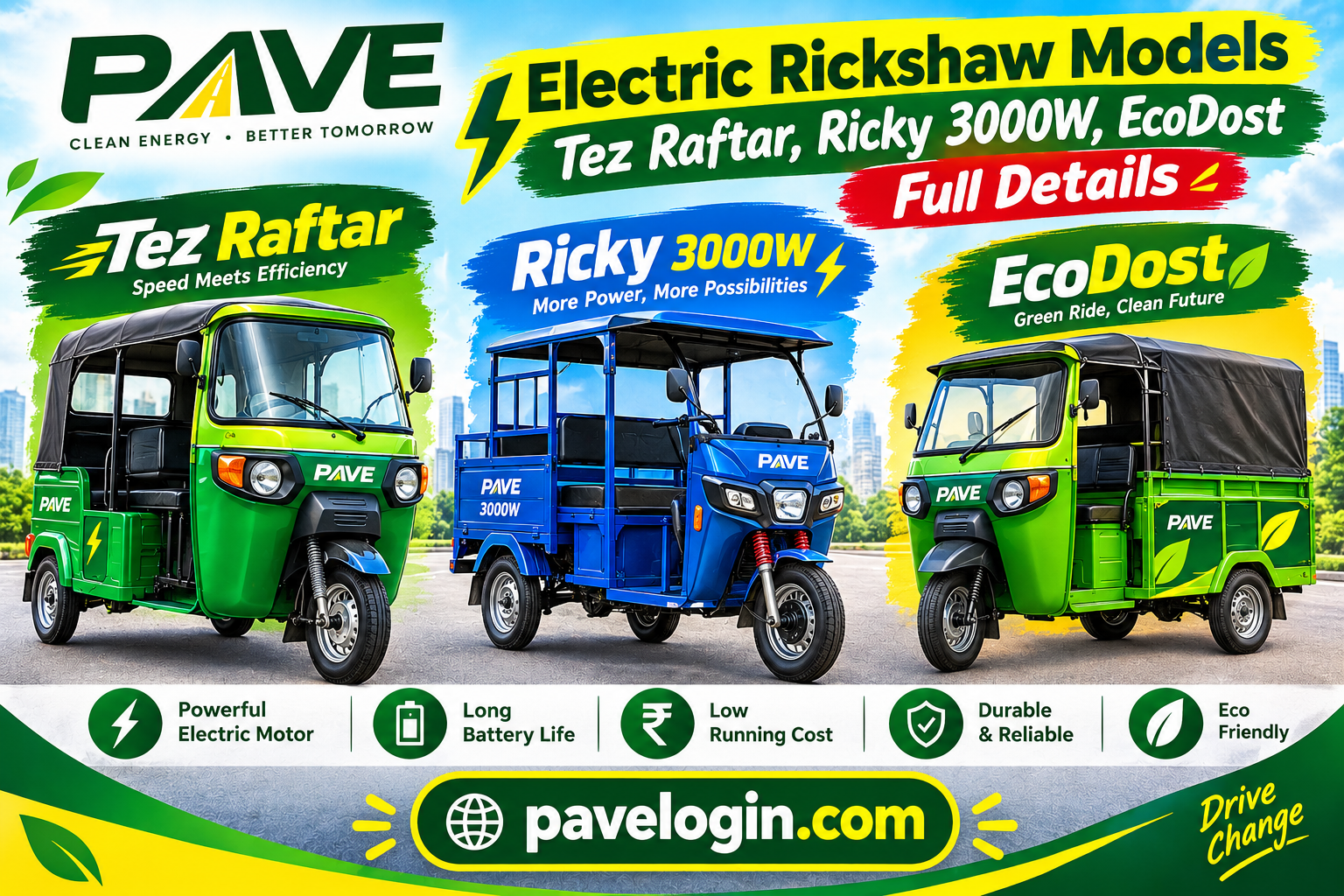
Read More About: Electric Rickshaw Models Tez Raftar, Ricky 3000W, EcoDost Full Details
Who may consider it?
The Ricky 3000W may be worth considering for drivers who:
- Operate the vehicle for several hours every day
- Regularly carry multiple passengers
- Travel on routes with inclines
- Need stronger acceleration than a lower-powered model
- Want a higher-power electric drivetrain without moving to a more expensive premium configuration
The most important purchase checks are battery warranty, payload capacity, controller specifications, service support, and the cost and availability of replacement components.
NOVA Mobility EcoDost Electric Rickshaw
The EcoDost occupies a different position in this comparison. Its reported drivetrain uses a 3500W PMSM motor rather than the BLDC motors listed for the other two models.
Reported specifications
| Specification | NOVA Mobility EcoDost |
|---|---|
| Motor | 3500W PMSM Hairpin |
| Battery | 76.8V, 105Ah LiFePO4 |
| Reported top speed | Up to 50 km/h |
| Reported range | Around 100 km, depending on configuration |
| Extended range | Reported configurations may offer up to 200 km |
| Charging time | Approximately 6–8 hours |
| Reported price | Approximately PKR 1.176 million |
PMSM versus BLDC
One of the main technical differences in this comparison is the motor type.
BLDC and PMSM motors are both permanent-magnet electric motor technologies, but their control methods and construction can differ. PMSM systems are widely used in modern electric vehicles because they can provide efficient operation and precise motor control.
The term “hairpin” generally refers to a particular stator-winding construction in which rectangular conductors are formed into hairpin shapes. It is a manufacturing and motor-design feature rather than a guarantee of superior real-world performance in every application.
For buyers, the more useful question is how the complete motor, controller, battery, cooling system, and vehicle design perform under the intended operating conditions.
Battery flexibility
The EcoDost is also reported to have battery options that can extend the vehicle’s usable range. If a swappable-battery configuration is actually available for the specific variant being purchased, it could be useful for commercial operations where waiting for a conventional recharge is difficult.
However, buyers should confirm whether the quoted price includes the required battery packs, charger, and swapping equipment. Battery configuration can have a major effect on the final purchase cost.
Tez Raftar vs Ricky 3000W vs EcoDost
The following table brings the reported specifications together for easier comparison.
| Feature | Tez Raftar 1800W | Ricky 3000W | EcoDost |
|---|---|---|---|
| Motor type | 1800W BLDC | 3000W BLDC | 3500W PMSM |
| Battery chemistry | LiFePO4 | Lithium-based | LiFePO4 |
| Reported battery configuration | 72V / 150Ah | 72V / 150Ah | 76.8V / 105Ah |
| Reported top speed | 42 km/h | 50 km/h | 50 km/h |
| Reported maximum range | Up to 170 km | Up to 180 km | Approximately 100–200 km depending on configuration |
| Reported charging time | Around 6 hours | Around 6 hours | Around 6–8 hours |
| Approx. reported price | PKR 800,000 | PKR 1.035–1.040 million | PKR 1.176 million |
| General positioning | Urban/local transport | Commercial use | Higher-specification/fleet applications |
Important: These figures are useful for initial comparison but should not be treated as independently verified performance measurements. Buyers should obtain the latest official quotation and specification sheet for the exact model and battery configuration before making a purchase.
What Determines the Real Cost of an Electric Rickshaw?
Purchase price is only one part of the financial calculation. A commercial operator should consider the vehicle’s total operating cost.
1. Electricity consumption
The amount of electricity used per kilometer depends on vehicle weight, passenger load, speed, road conditions, tyre pressure, battery condition, and driving style.
Instead of relying solely on an advertised range figure, an operator can calculate expected energy cost using the vehicle’s measured electricity consumption and the local electricity tariff.
2. Battery replacement
The battery is one of the most important components of an electric rickshaw. Before purchasing, ask for:
- Battery warranty period
- Expected warranty conditions
- Replacement battery price
- Battery-management-system details
- Availability of individual replacement components
- Recommended charging procedure
A lower purchase price can become less attractive if replacement batteries or specialized components are difficult to obtain.
3. Charging arrangements
Drivers should consider where and when the vehicle will be charged. A vehicle with a six-hour charging requirement may work well for an operator who can charge overnight, but the same arrangement may be inconvenient for someone who needs continuous daytime operation.
Swappable batteries can potentially reduce downtime, but the economics depend on the price and availability of additional battery packs.
4. Payload and road conditions
Range and acceleration should always be considered alongside payload.
A vehicle carrying several passengers on uneven roads or inclines can use substantially more energy than the same vehicle operating with a light load on flat roads.
For commercial use, buyers should therefore ask for the manufacturer’s official gross vehicle weight, payload rating, axle specifications, and gradeability information rather than judging capability solely from motor wattage.
How to Choose Between the Three Models
There is no single electric rickshaw configuration that suits every operator.
Tez Raftar 1800W
The Tez Raftar can be considered when the main priorities are a comparatively lower purchase price and routine urban transportation. It makes more sense for predictable, relatively flat routes where extremely high power is not required.
Ricky 3000W
The Ricky 3000W is more relevant to operators who place greater importance on motor output and commercial-duty operation. Its higher motor rating may provide an advantage in situations involving heavier loads or inclines, subject to the manufacturer’s actual torque and payload specifications.
EcoDost
The EcoDost is positioned toward buyers interested in a higher-specification drivetrain and potentially more flexible battery arrangements. Its higher reported purchase price means buyers should compare the additional features against their actual operating requirements rather than assuming that a more expensive vehicle will automatically produce greater financial returns.
Questions to Ask the Dealer Before Purchase
A test drive is useful, but commercial buyers should also request written information.
Ask the dealer for:
- The current ex-showroom and on-road price
- Battery warranty and motor warranty
- Maximum permitted payload
- Real-world or test-condition range
- Charger output and charging requirements
- Replacement-battery price
- Availability of spare parts
- Service-center locations
- Controller and motor warranty terms
- Registration and documentation requirements
- Whether the quoted price includes the battery
- Whether the advertised range applies to the standard or optional battery configuration
These questions can reveal differences that are not visible in a basic specification table.
Electric Rickshaw Buying Checklist for Pakistan
Before paying an advance, compare the complete package rather than only the vehicle’s headline specifications.
Battery: Confirm chemistry, capacity, warranty, and replacement cost.
Motor: Check rated power, controller specifications, torque characteristics, and warranty.
Range: Ask whether the quoted figure is a laboratory/ideal figure or based on a defined test condition.
Charging: Confirm charging time, charger warranty, and whether a home or commercial electrical connection is suitable.
Payload: Make sure the manufacturer’s rated payload matches the intended passenger or cargo operation.
Service: Check whether parts and trained technicians are available in your city.
Total cost: Include registration, insurance where applicable, charger, additional battery packs, maintenance, and financing costs when calculating the purchase budget.
Final Takeaway
The Tez Raftar 1800W, Ricky 3000W, and NOVA Mobility EcoDost represent three different approaches to electric three-wheeler ownership.
The Tez Raftar 1800W is oriented toward lower-cost urban transportation. The Ricky 3000W places greater emphasis on motor output for commercial operation. The EcoDost adds a higher-rated PMSM drivetrain and battery-configuration options aimed at users who need a more feature-oriented electric platform.
The advertised specifications provide a useful starting point, but they should not be treated as a substitute for a current dealer quotation or an independent road test. Actual range, charging performance, payload capability, and running costs can vary significantly according to operating conditions.
For a commercial operator, the most useful comparison is therefore not simply “Which vehicle has the biggest motor?” but “Which combination of purchase price, battery capacity, payload, charging arrangement, service support, and operating cost matches my daily route?”