
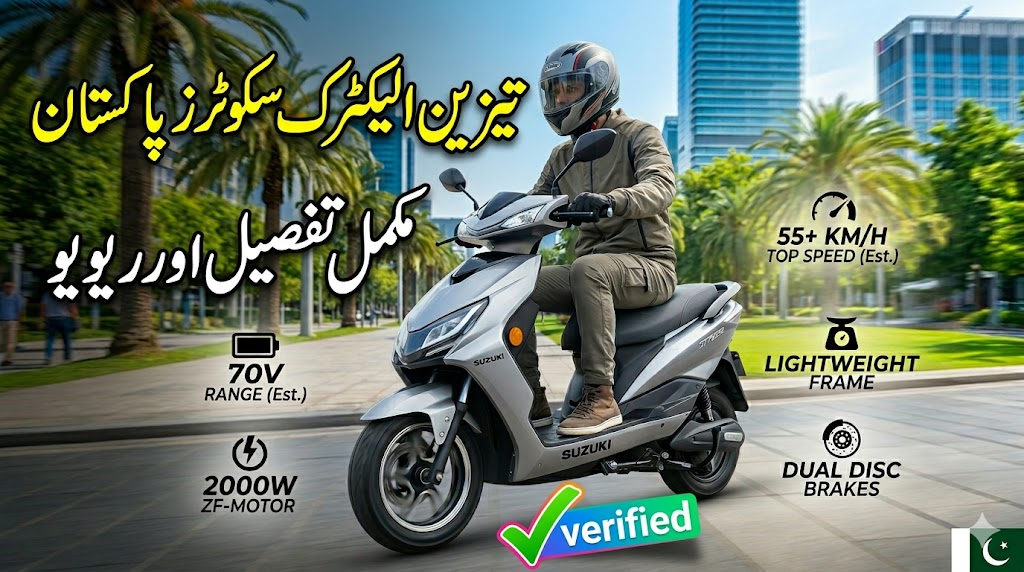
The economic dynamics of daily commuting in Pakistan have undergone a radical transformation. With volatile petroleum pricing impacting personal savings and fluctuating fuel supply rates challenging household budgets, reliance on conventional internal combustion engines has become an expensive luxury. While traditional petrol motorcycles offer familiarity and speed, they come shackled to continuous oil changes, mechanical valve tuning, and escalating fuel expenditures.
This financial strain has pushed high-speed electric scooters from a niche lifestyle alternative into an absolute practical necessity. Blending zero-emission mechanical assemblies with instant torque acceleration and low operating overheads, these modern performance scooters offer a direct technical solution to urban mobility challenges. This guide takes a deep look into motor capacities, battery variations, local market pricing structures, and real-world returns on investment (ROI).
1. Defining True High-Speed Electric Performance
Unlike low-tier electric mobility units designed for slow neighborhood tracks, a true high-speed electric scooter in Pakistan is classified by its ability to safely integrate into fast-flowing urban traffic streams. Mechanically, this requires a minimum power baseline of a 1000W brushless DC (BLDC) hub motor or mid-drive motor system.
These advanced powertrains focus directly on linear torque distribution, ensuring that the vehicle maintains momentum when scaling steep flyovers or carrying dual passengers—performance limitations common to lower-wattage variations.
2. Powertrain Categorization & Velocity Benchmarks
The operational behavior of an electric scooter depends heavily on the rated wattage output of its motor and the voltage output of its controller module.
Performance Dynamics Index
| Motor Power Rating | Realistic Top Speed | Optimized Commuting Profile |
| 1000W Baseline | 45 km/h to 50 km/h | Suited for students and structured residential commutes. |
| 1500W Mid-Tier | 55 km/h to 65 km/h | Designed for rapid cross-city transit through peak urban traffic lanes. |
| 2000W+ Premium | 70 km/h to 85+ km/h | Engineered for high-speed arterial roads and maximum cargo tolerance. |
📌 Pro Performance Rule: Higher motor wattage does not simply mean faster top speeds. It translates directly to enhanced torque acceleration, which allows the vehicle to safely accelerate out of dangerous blind spots in dense traffic conditions.
3. Battery System Analysis: Graphene vs. Lithium
The energy storage system serves as the financial heart of an electric scooter. Local distributors across Pakistan rely on two distinct cell configurations, each presenting unique tradeoffs:
A. Graphene Battery Packs
Graphene variations represent a heavily reinforced version of traditional lead-acid technology. While they are notably heavy and require secure frame placement to manage the center of gravity, they are highly cost-effective to replace upfront. They offer steady, predictable power delivery but add considerable kerb weight to the scooter chassis.
B. Lithium-Ion / Lithium Iron Phosphate (LFP) Packs
Lithium energy modules are exceptionally lightweight, allowing for agile handling and shorter stopping distances. Furthermore, they deliver consistent power output, meaning the scooter’s acceleration profile does not degrade as the battery drops below 30% charge. Premium variations feature removable lithium trays, enabling users to carry the battery indoors for convenient charging.
4. Real-World Financial Savings Calculator
To demonstrate why swapping a petrol-dependent vehicle for a high-speed electric scooter is a smart long-term move, let’s break down the mathematical operating costs over a 1,200 km monthly commute:
Daily Running Cost Comparison
- The Petrol Baseline: A standard 70cc or 125cc motorcycle covering 1,200 km a month at an efficiency of 42 km/L consumes roughly 28.5 liters of fuel. At an estimated average price of Rs. 310 per liter, the monthly fuel cost reaches Rs. 8,835 (excluding regular engine oil replacement costs).
- The High-Speed Electric System: A premium 72V 30Ah battery pack requires roughly 2.1 kWh (units) of electricity to complete a full 0% to 100% charge cycle. At an estimated domestic utility tariff rate of Rs. 50 per unit, a complete charge costs approximately Rs. 105. Since one full charge yields a real-world range of up to 90 km, the operation cost is remarkably low:
$$\text{Monthly Charging Cost} = \left( \frac{1,200 \text{ km}}{90 \text{ km}} \right) \times \text{Rs. 105} \approx \textbf{Rs. 1,400}$$
Net Monthly Household Savings:
$$\text{Net Savings} = \text{Rs. 8,835 (Petrol)} – \text{Rs. 1,400 (Electric)} = \textbf{Rs. 7,435}$$
This yields over Rs. 89,000 in direct annual savings, allowing the vehicle to completely offset its initial purchase premium within its standard factory warranty window.
5. Current Market Pricing Landscape
The initial investment for high-speed electric models varies based on battery configuration, integrated tech features, and localized assembly methods.
- Entry-Level High-Speed (Graphene-based 1000W–1500W): Ranging from Rs. 165,000 to Rs. 235,000. These models, like the Evee S1 Standard or Metro T9 Eco, offer a great entry point into the market.
- Mid-Range Commuters (1500W Lithium / High-Capacity Graphene): Ranging from Rs. 245,000 to Rs. 315,000. Popular configurations in this tier include the Metro E8S Pro and the Evee S1 Air Lithium.
- Premium Performance Tier (2000W+ Lithium / LFP Trackers): Ranging from Rs. 340,000 to Rs. 440,000+. This include high-end models such as the Yadea Velax H or Vlektra Velocity 180, which offer advanced tech features and maximum durability.
6. Objective Evaluation: Advantages and Structural Limits
✅ Advantages
- Drastic Operating Cost Reduction: Lowers daily energy costs by up to 80% compared to traditional fuel options.
- Zero Engine Upkeep: Eliminates recurring expenses for engine oil swaps, spark plug checks, drive chain adjustments, and air filter replacements.
- Smooth, Quiet Ride: The linear power delivery completely removes engine noise and mechanical vibrations, which helps reduce rider fatigue during long commutes.
❌ Limitations
- Refueling vs. Recharging Time: Topping up a battery requires a 4-to-6-hour charging window, unlike a quick 2-minute petrol refuel.
- Higher Initial Cost: Models equipped with high-capacity Lithium or LFP battery setups require a higher upfront investment compared to entry-level petrol options.
7. Safety & Long-Term Maintenance Best Practices
To extract maximum performance and keep your high-speed electric scooter running efficiently, follow these essential guidelines:
- Avoid Deep Discharges: Try not to let your battery drop below 15% charge regularly. Keeping the cells properly topped up helps prolong their overall lifespan.
- Mind the Temperature: Avoid parking your scooter directly under intense afternoon sunlight after long commutes. Letting the battery cool down before plugging it in helps protect the cells from thermal stress.
- Brake Maintenance: Because high-speed electric variants carry heavier battery packs, checking brake shoe wear and keeping hydraulic fluids topped up is critical for safe stopping power.
Read More About: EV 125 Electric Scooter Review Battery Motor and Riding Experience
Frequently Asked Questions (FAQs)
Are high-speed electric scooters legal for main city roads in Pakistan?
Yes, high-speed electric models are fully certified for city street use. Variants capable of speeds exceeding 50 km/h are registered under provincial Excise and Taxation departments, ensuring complete legal peace of mind.
Can I charge my high-speed scooter using a standard home wall outlet?
Yes, all major models come equipped with intelligent, auto-shutoff smart chargers that plug directly into standard 220V domestic wall sockets.
Does riding at maximum top speed affect the driving range?
Yes, high-speed driving increases aerodynamic drag and draws more current from the battery. Riding consistently at maximum velocity can reduce your estimated range by roughly 20% to 25% compared to keeping a steady pace in eco-mode.